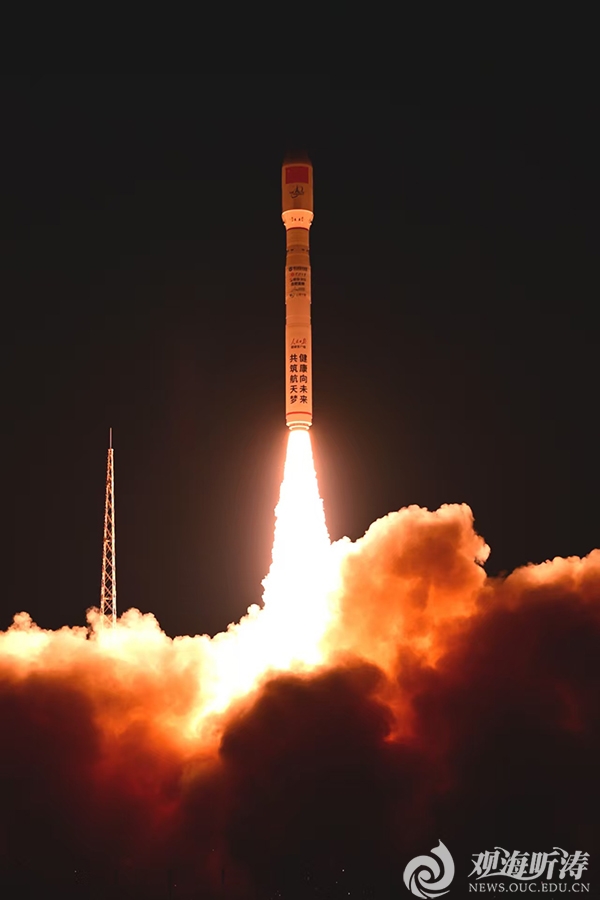
At 7:37 a.m. on November 7, Laoshan Laboratory’s Guanlan Experimental Satellite, with Professor Chen Ge of Ocean University of China (OUC) serving as its chief scientist, lifted off aboard a Ceres-2 launch vehicle from the Jiuquan Satellite Launch Center. The satellite entered its designated orbit as planned, marking the successful completion of the launch mission.
Developed by Laoshan Laboratory to advance research at the frontiers of marine science and address major needs in the field, the Guanlan Experimental Satellite is the world’s first small satellite equipped with a Ka/Ku dual-band synthetic aperture radar altimeter. It employs a dual-band co-aperture antenna configuration and a low-Earth-orbit design, offering high gain, high precision, and high resolution. It is also the world’s smallest and lightest altimeter satellite. Once operational in orbit, it will conduct routine, around-the-clock, all-weather, fine-scale, and timely observations of global sea surface height, laying crucial groundwork in science and technology, engineering, and management for the subsequent development and application of satellites in this field.
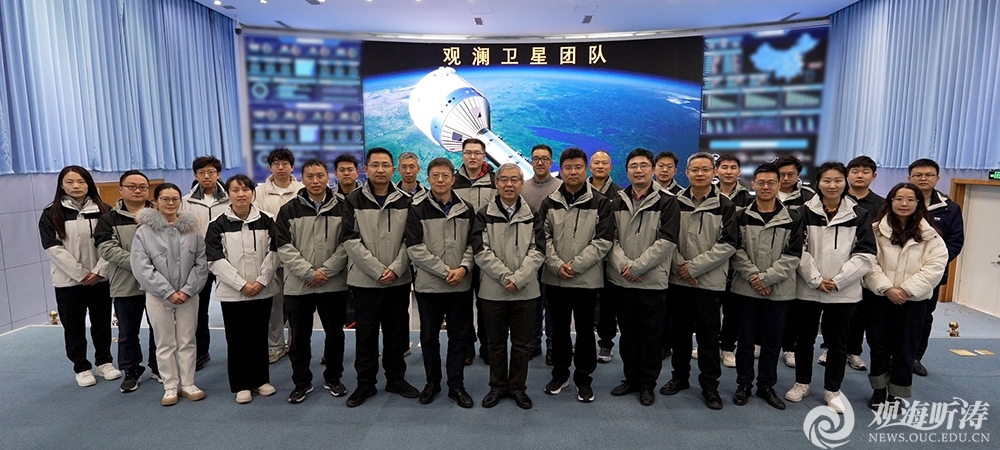
OUC’s team of jointly appointed researchers played a key role in the satellite’s overall engineering design, ground system development, calibration and validation, and other related work. The successful launch of the Guanlan Experimental Satellite reflects the close integration between OUC and Laoshan Laboratory. It will also provide strong support for developing “Remote Sensing Science and Technology” as a first-level academic discipline at OUC. Looking ahead, OUC will continue to leverage its distinctive strengths in marine disciplines, closely align its work with major national strategic needs, and deepen cooperation with Laoshan Laboratory in talent development, scientific and technological innovation, and platform development. By fully leveraging the strengths of the science and technology innovation consortium for marine observation and detection, the two institutions will jointly advance the implementation and scientific applications of the major Guanlan satellite project and contribute to strengthening China’s marine sector.