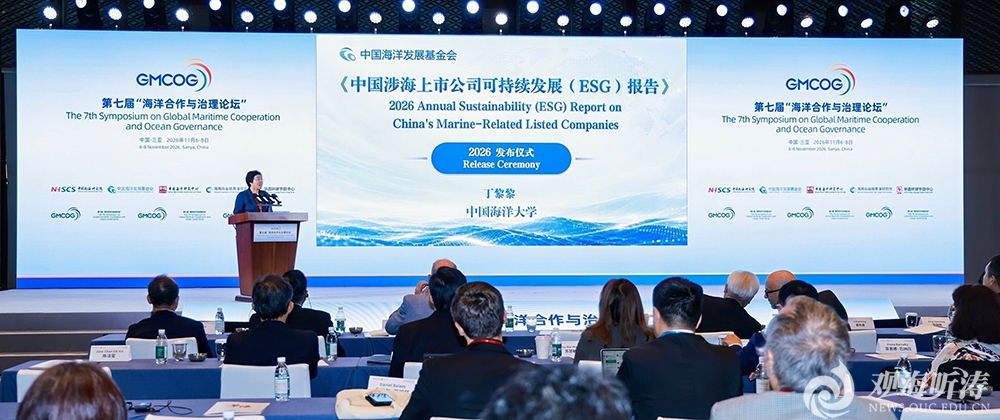
On November 7, the Blue Book of Listed Companies: 2026 Annual Sustainability (ESG) Report on China’s Marine-Related Listed Companies was officially released during the closing ceremony and the presentation of outcomes from practical maritime cooperation projects at the 7th Symposium on Global Maritime Cooperation and Ocean Governance in Sanya, Hainan. Professor Ding Lili, editor-in-chief of the Blue Book and Director of the Office of Undergraduate Academic Affairs at Ocean University of China (OUC), presented the publication and introduced its background, the approach adopted in its preparation, and its highlights. The launch brought together a broad range of representatives from government agencies, marine-related industries, universities, and research institutions, who shared their assessments of the report from different perspectives.
Representatives from government agencies noted that, drawing on robust sample data, the report maps the performance patterns and areas of weakness of marine-related listed companies across the environmental, social, and governance dimensions. It provides a useful reference for understanding the overall trajectory of the sustainable transformation of marine industries. By highlighting differences in ESG performance across sectors, the report helps identify key sectors and priorities for the green transformation of marine industries. It also enables relevant authorities to better coordinate industrial upgrading, ecological protection, and risk prevention and control when formulating marine industry policies, thereby making policy measures more targeted and better coordinated.
Industry representatives noted that the report’s sector-specific assessments offer clear benchmarking value. By evaluating representative sectors such as offshore oil and gas, port services, and shipbuilding in terms of their low-carbon transition, pollution control outcomes, and governance effectiveness, the report helps companies more clearly identify gaps in supply chain ESG management, climate risk response, and the standardization of governance practices. Against a backdrop of increasingly stringent international green regulations and rising compliance requirements for overseas operations, this assessment framework provides companies with a practical reference for embedding ESG principles into their international strategies and day-to-day operations.
Experts from universities and research institutions noted that, grounded in the context of China’s marine economy, the report establishes an analytical framework covering nine sectors, three dimensions, and twelve specific aspects. It provides a comprehensive analysis of the underlying issues affecting the sustainable development of marine-related enterprises. In particular, its examination of cross-cutting issues, such as improving ESG assessment systems and fostering new quality productive forces in the marine sector, provides the academic community with empirical evidence for connecting theoretical research with China’s strategic needs in the marine sector. It also helps deepen research into the sustainable development of the marine economy in the context of Chinese modernization.
The release of the Blue Book of Listed Companies: 2026 Annual Sustainability (ESG) Report on China’s Marine-Related Listed Companies represents a concrete step by OUC to support efforts to strengthen China’s marine sector and advance research on the sustainable development of the marine economy. During the 15th Five-Year Plan period, the pursuit of high-quality development in the marine economy will place greater demands on the sustainability capabilities of marine-related market entities. Building on the editorial team’s successive editions of the Blue Book of China’s Marine Economy, the new report represents another major achievement. It extends the team’s research from an overall analysis of the marine economy to assessments of the sustainability of individual market entities, marking a further step in OUC’s sustained and systematic research on the marine economy. OUC will continue to draw on its disciplinary strengths in research on the high-quality development of the marine economy, capital markets, and ESG governance. From an academic perspective, it will monitor annual sustainability trends among marine-related listed companies and deepen research that integrates theory and practice. These efforts will provide a scholarly basis for policymaking by marine authorities and intellectual support for marine-related companies seeking to enhance their competitiveness in sustainable development.