On October 31, the 23rd Annual Meeting of the Chinese Institute of Food Science and Technology (CIFST) was held in Kunming. At the meeting, China’s Top Ten Food Science and Technology Advances of 2026 were announced. The project “Key Technologies and Products for Cell-Cultured Fish Meat Production,” led by Chinese Academy of Engineering member Xue Changhu of the State Key Laboratory of Marine Food Processing and Safety Control at Ocean University of China (OUC), was named to the list, marking the first time an OUC research achievement had received the honor.
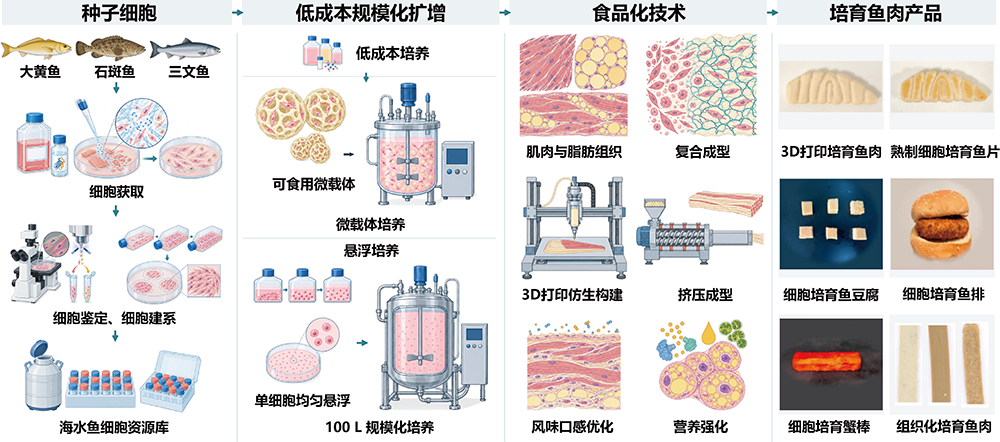
Developing novel marine food resources is an important way to support China’s efforts to strengthen its marine sector, put the all-encompassing approach to food into practice, and advance the Healthy China initiative. It is also an important direction for fostering new quality productive forces in the marine sector and aligning with the new biomanufacturing paradigm for China’s 15th Five-Year Plan period. Cell-cultured fish meat is produced by culturing marine fish cells in vitro, directing their differentiation, and structuring them into edible fish meat, thereby using nutrients directly for meat production. The technology could reduce conventional aquaculture’s dependence on whole organisms, natural growth cycles, and aquatic space, opening new pathways for a stable supply of high-quality marine protein and for the production and sustainable use of high-value aquatic products. The industry currently faces bottlenecks including shortages of high-performance seed cells, affordable serum replacements, and edible scaffolds, as well as inadequate technologies for large-scale cell expansion and food structuring. To address these challenges, the team developed a system for the efficient discovery and directed adaptation of marine fish cells and established a marine fish cell bank. It also developed a novel serum replacement suitable for multiple cell types and pioneered edible macroporous microcarriers and a process for their consistent production. In addition, the team achieved breakthroughs in efficient cell-culture scale-up and process intensification, and developed a system for the structuring and targeted nutritional regulation of high-quality, customized cell-cultured fish meat. Together, these advances created an integrated industrialization pathway from seed cells and low-cost expansion to food structuring. Overall, the work improved the efficiency, stability, and applicability of cell culture for aquatic species, helped move cell-cultured fish meat from laboratory research toward industrial-scale production, and provided key theoretical and technical support for expanding the supply of high-quality protein from aquatic sources and advancing food biomanufacturing. Related findings have been published in journals including Nature Communications and Journal of Agricultural and Food Chemistry.
China’s Top Ten Food Science and Technology Advances have been selected biennially since 2022. Organized by CIFST, the program is open to universities and colleges with food-related programs, research institutes, enterprises, and frontline science and technology professionals across China. The selection process comprises application, formal screening, oral defense, and expert review. The program aims to showcase major breakthroughs in China’s food science and technology and highlight the leading role and cutting-edge nature of developments in the field.