On October 27, a ceremony recognizing the 2026 “Qilu Most Beautiful Sci-tech Workers” was held in Jinan. Professor Li Sanzhong of Ocean University of China (OUC)’s Key Laboratory of Submarine Geosciences and Prospecting Techniques, Ministry of Education, received the title.
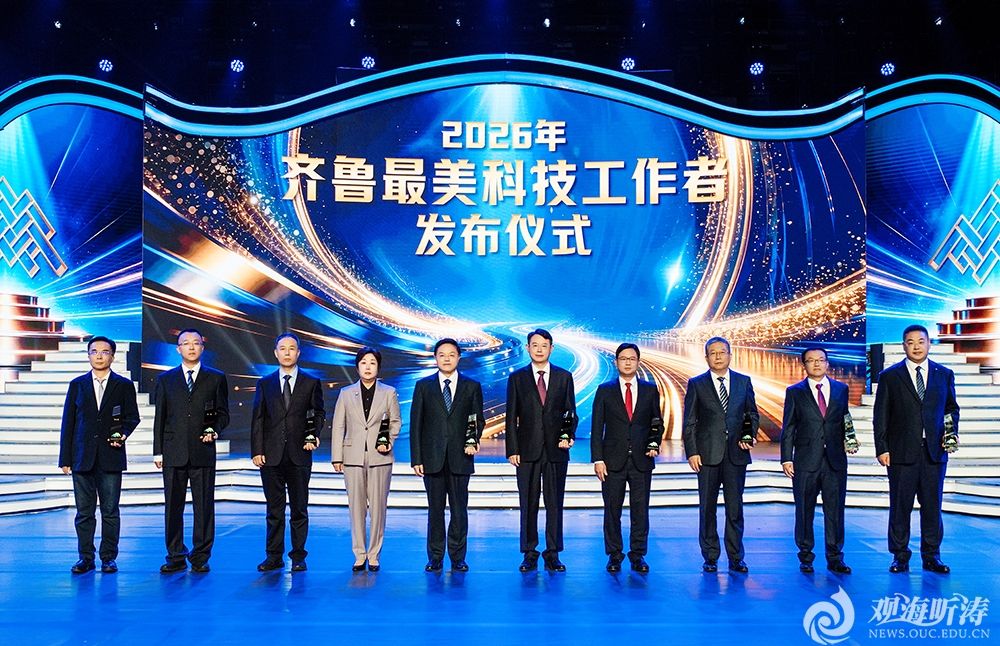
The 2026 campaign to select and promote the 2026 “Qilu Most Beautiful Sci-tech Workers” aims to implement Xi Jinping Thought on Socialism with Chinese Characteristics for a New Era, carry forward the spirit of scientists, encourage sci-tech workers to learn from and strive to emulate the honorees, and rally support for strengthening Shandong’s science and technology sector. Following extensive outreach, organizational nominations, expert review, and public notification, ten individuals and teams across the province received the title.
Professor Li Sanzhong has long conducted research on seafloor geoscience and exploration technologies. He has served as chief scientist of the key project “Research on Key Technologies for Integrated Onshore-Offshore Deep Geophysical Exploration” under the National High-tech R&D Program of China, and the NSFC Science Fund for Creative Research Groups project “Dynamic Reconstruction of Submarine Paleogeomorphology.” Focusing on key scientific questions concerning the operation of the Earth system and the formation and accumulation of clean energy resources beneath the seafloor, he has made a series of innovative advances. He pioneered the theory of microplate tectonics, resolving three major questions left unanswered by classical plate tectonic theory for six decades. He also proposed an original theory of seafloor hydrogen energy, challenging the century-old conventional belief that the ocean floor contains no energy resources. In recent years, he has published more than 600 academic papers in leading international journals, including Nature Geoscience and Nature Communications, and has been included among globally highly cited researchers and the world’s top 2% of scientists.