Recently, a research team led by Professor Zhou Longwen of the College of Physics and Optoelectronic Engineering, Faculty of Information Science and Engineering,at Ocean University of China (OUC) made new progress in the study of Floquet critical topological phase transitions. The findings were published in Nature in an article entitled “Observation of critical topological phase transition.”
Topological states of matter and critical points of phase transitions have long been regarded as “two disconnected islands” in condensed-matter physics. Topological phases require an energy gap and are characterized by discrete, quantized invariants, whereas critical points occur precisely where the gap closes, rendering conventional topological invariants ill-defined. Using an acoustic metamaterial, the latest study experimentally demonstrated for the first time how topology can “survive” at criticality and actively reorganize critical behaviour, thereby revealing a novel critical topological phase transition.
Professor Zhou Longwen collaborated with a research team led by Professor Zhang Baile of Nanyang Technological University, as well as Professor Yu Xuejia of Eastern Institute of Technology and Professor Gong Jiangbin of the National University of Singapore, designed a periodically driven (Floquet) topological system based on an acoustic waveguide array. In this system, propagation along the waveguide direction plays the role of time evolution, while the transverse direction encodes the spatial lattice. Using a 3D-printed acoustic waveguide array, the team precisely engineered the geometries of straight tubes, which implement nearest-neighbour coupling, and curved tubes, which implement next-nearest-neighbour coupling. This enabled them to realize the desired topological parameters at an operating frequency of 9.8 kHz and extract the quasienergy spectrum from experimental data by reconstructing the Floquet operator. This approach provides a broadly applicable framework for investigating quantum critical topological phenomena in classical-wave systems.
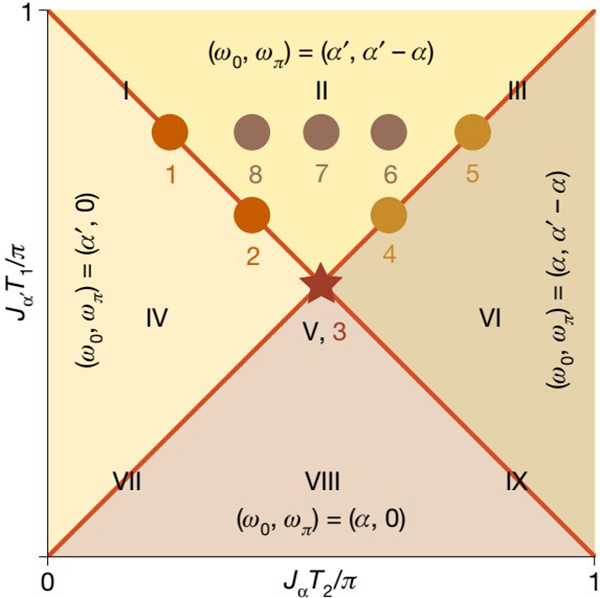
Unlike static systems, the Floquet quasienergy spectrum is defined on a compact circle and supports two distinct quasienergy gaps at 0 and π, whose intertwined topological roles give rise to extended gapless critical phase boundaries. The team observed four critical 0-quasienergy edge states along phase boundary I and two critical π-quasienergy edge states along phase boundary III. At the multicritical point V, where these two topologically distinct critical boundaries intersect, both quasienergy gaps close simultaneously and the topological edge states undergo a reconfiguration—a hallmark of a critical topological phase transition. By measuring both the amplitude and phase of the acoustic pressure field, the team reconstructed the full Floquet operator and extracted the quasienergy spectrum, directly verifying the theoretically predicted distribution of edge states. The researchers used entanglement entropy as a diagnostic of criticality. In a one-dimensional critical system, entanglement entropy scales logarithmically with subsystem size, with the slope defining an effective entanglement coefficient. Along phase boundaries I and III, the entanglement entropy exhibited logarithmic scaling. At the multicritical point V, the experimentally measured entanglement coefficient was exactly equal to the sum of the coefficients for the two adjacent boundaries. This additive scaling relation provides direct evidence of topology-enriched multicriticality.
Drawing on systematic theoretical and experimental investigations, this study shows that topology can not only “survive” at criticality but also organize continuous critical fluctuations through discrete topological structures. In other words, even two critical points with identical critical exponents may belong to different universality classes because of their distinct topological properties, thus going beyond the conventional Landau-Ginzburg framework for classifying phase transitions. The study advances the recently developed theoretical concept of “critical topology” towards experimental validation. It demonstrates not only that topology and criticality are compatible, but also that topology can actively drive phase transitions and reorganize criticality, thereby establishing a hierarchical organization of phase transitions. This framework could potentially be extended to photonic and cold-atom platforms, as well as superconducting quantum circuits, and may provide new experimental probes for exploring nonequilibrium critical dynamics beyond the Kibble-Zurek mechanism.