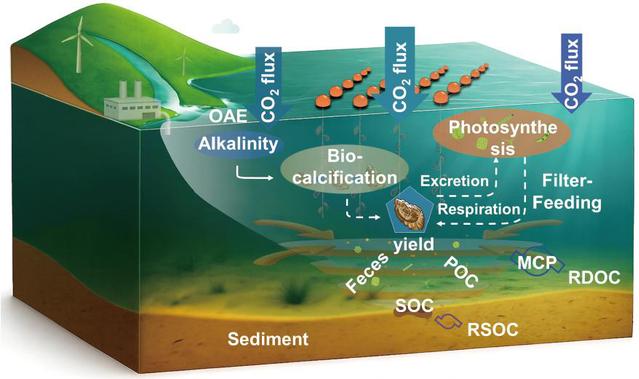
Recently, a research team led by Professor Dong Shuanglin from the College of Fisheries at Ocean University of China (OUC) published a research article entitled “Synergy of ocean alkalinity enhancement with biological carbon pump for marine CO2 removal in the coastal ecosystem with oysters” in Environmental Science & Technology, revealing that Ocean Alkalinity Enhancement (OAE) and oyster farming synergistically enhanced carbon storage and sequestration and elucidated the mechanisms underlying this synergy.
By increasing seawater alkalinity, OAE enhances the ocean’s capacity to absorb atmospheric CO2, making it a promising strategy for meeting global climate change mitigation goals. However, critical knowledge gaps remain regarding the effectiveness and mechanisms of OAE treatment in coastal waters. In the open ocean, OAE may promote the proliferation of calcifying phytoplankton coccolithophores, thereby reducing the CO2 removal potential of OAE. Recent studies have also indicated that the farming of the calcifying organism oyster can raise the pH in the ecosystem. Therefore, before the extensive deployment of OAE in coastal waters, it is essential to clarify the interactions between OAE and oyster farming in carbon dioxide removal (CDR).
The study found that, compared with OAE alone, combining moderate OAE treatment (total alkalinity of approximately 2700 μmol·kg–1) with oyster farming increased the potential of ecosystem carbon storage and long-term carbon sequestration by 40% and 270%, respectively. In addition, compared with oyster farming alone, the combined treatment increased protein yield by approximately 52%. However, excessively high alkalinity levels adversely affected ecosystem carbon storage and oyster growth. Scenario-based estimates indicated that global marine bivalve aquaculture production could reach 54.4-105.7 Mt per year by 2050. If combined with moderate OAE, the annual total CO2 storage associated with bivalve aquaculture was projected to reach 156.4-227.2 Mt, with an estimated long-term carbon sequestration potential of 25.5-51.2 Mt CO2-eq.
OAE initially lowers the partial pressure of CO2 in seawater, thereby driving atmospheric CO2 into the ocean. Subsequently, through filter feeding and nutrient regeneration, oysters stimulate phytoplankton production, allowing inorganic carbon to be further converted into organic carbon and transferred into dissolved, particulate, and sediment organic carbon pools. This organic carbon then provides substrates for the microbial carbon pump, which converts a portion of labile organic carbon into more refractory forms. Meanwhile, oyster calcification incorporates part of the inorganic carbon into shells. Together, the solubility carbon pump, biological carbon pump, microbial carbon pump, and carbonate pump became dynamically coupled, creating a synergistic pathway of “chemical capture—photosynthetic conversion—microbially mediated sequestration.”