Recently, a research team led by Professor Li Yiming from the Key Laboratory of Marine Chemistry Theory and Technology, Ministry of Education, at Ocean University of China, made new progress in oil-water separation membrane technology. The findings were published in Nature Water in an article entitled “Synchronous and parallel separation of opposing emulsions enabled by a heterowettability membrane.”
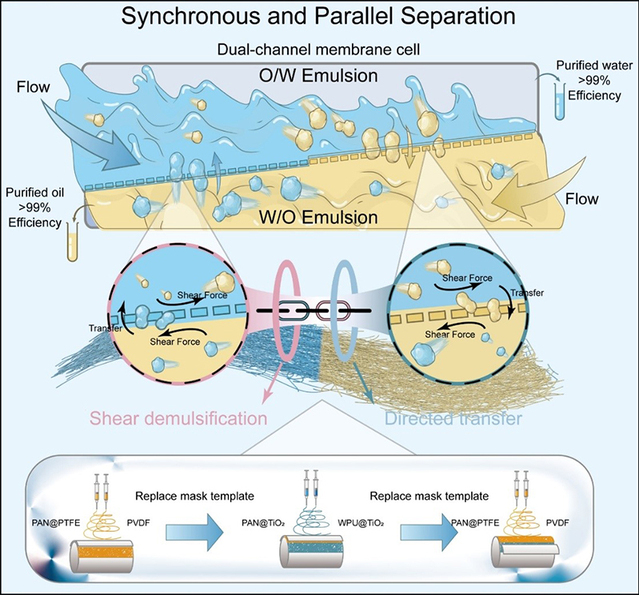
Oil-water emulsions are widespread in petrochemical processing, marine oil spills, food production, and industrial wastewater. Efficient oil-water separation has long been an important challenge in water treatment. Conventional membrane separation generally relies on pore-size sieving and wettability-driven interfacial demulsification: hydrophilic membranes are commonly used to treat oil-in-water (O/W) emulsions, whereas hydrophobic membranes are required for water-in-oil (W/O) emulsions. This sequential operating mode generally handles only one type of emulsion and yields only one pure phase per operation. When the feed composition changes, or when oppositely configured O/W and W/O emulsions coexist, the emulsion type must first be identified, the membrane material switched, or multistage treatment units added. This not only complicates the processes, but also increases energy consumption and maintenance costs. Consequently, developing a single membrane system capable of simultaneously treating these two oppositely configured emulsions without switching operating modes has become a key challenge in achieving more integrated oil-water separation.
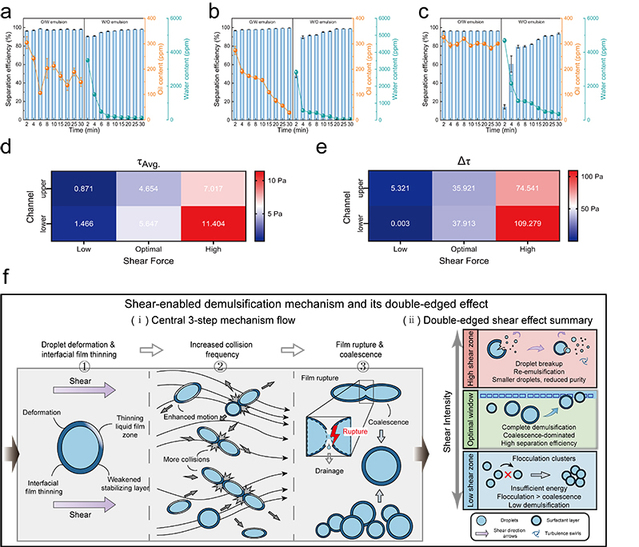
By combining a heterowettability membrane with hydrophilic and hydrophobic regions with a membrane cell featuring bidirectional gradient-flow channels, the study enabled synchronous demulsification and separation of multiphase oily wastewater. This system overcomes the single-function operation of conventional oil-water separation membranes and establishes a novel mechanism based on matching the membrane’s wettability topology to the flow configuration. It provides an effective new strategy for designing high-performance oil-water separation membranes. Computational fluid dynamics (CFD) simulations further revealed the hydrodynamic processes within the gradient flow channels. The system achieved a two-phase separation efficiency of over 99%, together with markedly improved antifouling performance and long-term stability. The study redesigned the emulsion separation process at three levels: membrane materials, flow-channel architecture, and interfacial transport mechanisms. It established an integrated mechanism of “shear-induced demulsification—wettability-directed transportation—Laplace interfacial anchoring,” enabling O/W and W/O emulsions to be processed continuously, synchronously, and in parallel within a single device. This work establishes a new paradigm for the synchronous separation and parallel treatment of opposing emulsions, and the shift from sequential filtration to parallel separation holds promise as a new technological pathway for oily wastewater treatment, oil recovery, and resource recovery from complex multiphase systems.