Recently, researchers from the Key Laboratory of Marine Genetics and Breeding, Ministry of Education, the Fang Zongxi Center for Marine Evo-Devo, and the Key Laboratory of Marine Chemistry Theory and Technology, Ministry of Education—all at Ocean University of China (OUC)—in collaboration with the Key Laboratory of Tropical Biological Resources, Ministry of Education, at Hainan University, made new progress in environmental DNA (eDNA) detection in aquatic environments. The findings were published online on August 31 in Communications Earth & Environment, a Nature Portfolio journal, in an article entitled “Enhancing aquatic ecosystem environmental DNA capture, preservation and analysis with magnetic spiky silica nanoparticles.”
Environmental DNA analysis is transforming the way we monitor aquatic ecosystems, but its large-scale implementation is often limited by eDNA enrichment and extraction methods that are costly, inefficient, and difficult to standardize across different environments. To address this bottleneck, the research team developed an innovative solution based on engineered magnetic spiky silica nanoparticles. The material features a high-surface-area, amine-modified spiky silica shell with tunable morphology and porosity, and a magnetic core, enabling the efficient capture and purification of eDNA directly from water samples without the need for complex laboratory equipment.
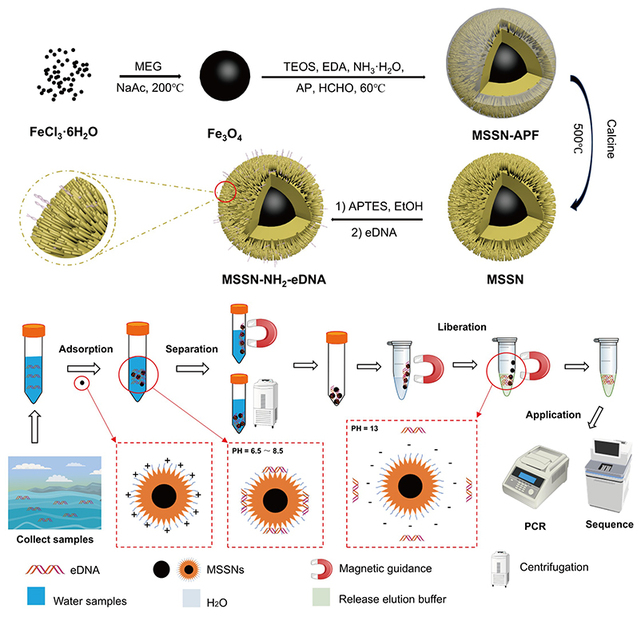
Experiments showed that the optimized workflow substantially outperformed commercial kits in eDNA yield, purity, and fragment recovery. It also allowed captured DNA to be preserved at room temperature, greatly facilitating sample transport and storage. In addition, the method is compatible with standard sequencing approaches, providing a scalable and cost-effective solution for large-scale, standardized eDNA-based monitoring of aquatic ecosystems.