Recently, a research team led by Professor Shen Chuanbin of the School of Medicine and Pharmacy at Ocean University of China (OUC), together with its collaborators, made new progress in elucidating the mechanisms underlying thrombosis and in the pharmacology of antithrombotic agents. The two studies were published online in Blood and Molecular Therapy, respectively, titled “The hepatic FGFR-ERK-HRG axis regulates heparin-induced thrombocytopenia with thrombosis” and “Targeting the MNK1-MYH9 axis blocks YAP1 recruitment to prevent thrombosis and platelet activation-induced NETosis.”
Thromboembolism is a leading cause of disability and death from cardiovascular and cerebrovascular diseases. In recent years, immunothrombosis, which arises from interactions among immune responses, platelet activation, and coagulation, has become a frontier area in research on thrombotic diseases. Heparin-induced thrombocytopenia (HIT) is an immune-mediated thrombotic disorder caused by antibodies against platelet factor 4 (PF4)-heparin complexes. It is characterized by a fall in platelet count following heparin treatment, accompanied by severe thrombotic events, with amputation or death occurring in up to 20%-30% of patients. This paradoxical phenomenon, in which anticoagulant therapy triggers thrombosis, has become a major clinical challenge in hematology, cardiovascular medicine, and critical care. The Chinese Expert Consensus on Heparin-Induced Thrombocytopenia noted that the epidemiology of HIT in China remained unclear and that relevant reports were limited, underscoring the urgent need for further basic and clinical research.
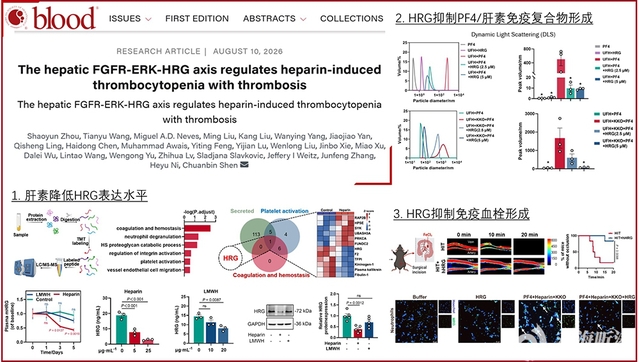
In the study published in Blood, the research team uncovered a new mechanism underlying HIT and HIT-associated thrombosis. The experiments showed that repeated heparin administration suppressed the hepatic FGFR-ERK-Elk1 signaling pathway and downregulated the expression of histidine-rich glycoprotein (HRG), establishing a positive-feedback loop— “reduced HRG → platelet activation → PF4 release → further HRG reduction”—that allowed the prothrombotic state to persist even after heparin clearance. HRG exerts dual protective effects. It binds directly to activated platelet integrin αIIbβ3 and blocks its ligand-binding capacity. It also inhibits the formation of ultralarge PF4-heparin complexes (ULCs), disrupts the resulting immune complexes, and attenuates ULCs-triggered autoantibody generation. For the first time, the study identifies the liver as an active participant rather than a bystander in HIT, offering new avenues for its early diagnosis, prevention, and treatment and providing a theoretical foundation for the development of novel polysaccharide therapeutics.
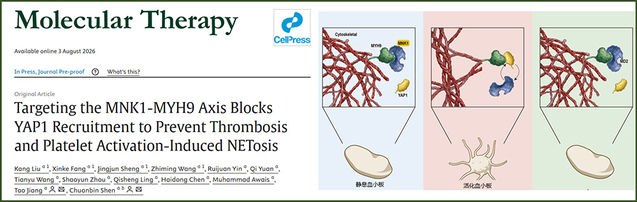
The study published in Molecular Therapy focused on the platelet-neutrophil extracellular trap (NET) interaction circuit in immunothrombosis, a pathological aspect not addressed by conventional antithrombotic drugs. The researchers found that MAPK-interacting kinase 1 (MNK1) interacts with the head domain of non-muscle myosin heavy chain 9 (MYH9) via its C-terminal motif and competitively blocks Yes-associated protein 1 (YAP1) from binding to MYH9 in resting platelets. Upon platelet activation, MNK1 dissociates from MYH9, allowing YAP1 to be recruited to MYH9 and drive cytoskeletal contraction and NETosis. This role of MNK1 is entirely independent of its canonical kinase activity. Building on these findings, the team developed a drug-development strategy based on protein-protein interaction (PPI) stabilization. They modified the marine bioactive compound MD2, which exerts antithrombotic effects by stabilizing the MNK1-MYH9 complex. Animal experiments showed that MD2 significantly reduced thrombus burden without significantly prolonging bleeding time, advancing antithrombotic drug development from conventional kinase inhibition toward a new paradigm centered on PPI stabilization.