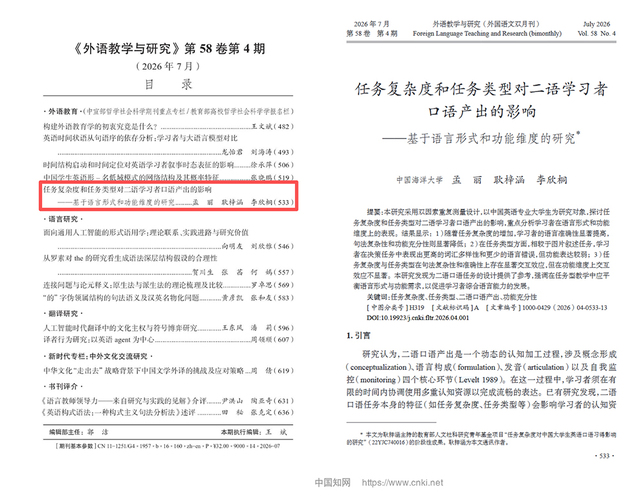
Recently, Ocean University of China’s (OUC) Interdisciplinary Research Group on Second Language Acquisition published an article entitled “Effects of Task Complexity and Task Type on L2 Learners’ Oral Production: A Study of Linguistic Form and Function Dimensions” in the 4th issue of Foreign Language Teaching and Research in 2026. The study systematically examines how task complexity and task type affect second language (L2) learners’ oral production. Going beyond previous research that focused mainly on linguistic form, it analyzes learners’ oral performance in terms of both linguistic form and function, providing empirical evidence for task design in task-based language teaching.
L2 oral production is a complex cognitive process in which learners must coordinate multiple processes, including language formulation, information expression, and self-monitoring, within a limited time. Previous studies have shown that task characteristics affect how learners allocate cognitive resources and thereby influence their oral performance. However, most previous studies have focused on a single task characteristic and the linguistic-form dimension, paying insufficient attention to interactions among task characteristics and to functional performance.
The study involved 37 Chinese university students majoring in English and adopted a two-factor repeated-measures design. It used two typical oral tasks, picture-story tasks and decision-making tasks, each under two levels of complexity: simple and complex. Learners’ oral performance was analyzed along two dimensions: linguistic form, comprising complexity, accuracy, and fluency; and function, measured in functional adequacy.
The findings fall into three main areas. First, with an increase in task complexity, learners’ language accuracy increased significantly, while syntactic complexity and functional adequacy decreased significantly. This suggests that greater task complexity increased learners’ cognitive load, leading them to prioritize the accuracy of linguistic form under conditions of limited attentional resources, while restricting their use of complex syntactic structures and their functional expressions.
Second, in terms of task type, compared with picture-story tasks, learners produced more diverse vocabulary and fewer language errors in decision-making tasks, but their functional expression was weaker. This may be because decision-making tasks require learners to compare and evaluate options, prompting them to use more analytical vocabulary, while clear task objectives facilitate language monitoring. However, the greater demands of information integration may lead learners to devote more attention to processing task content and monitoring linguistic form, resulting in incomplete coverage of task requirements and insufficiently developed justifications.
Third, a significant interaction effect between task complexity and task type was observed for syntactic complexity and accuracy, but not for the functional dimension. Specifically, as task complexity increased, linguistic accuracy improved in both task types, with a more pronounced improvement in picture-story tasks; a significant decline in syntactic complexity occurred mainly in picture-story tasks. These results indicate that the processing of linguistic form is highly dependent on the specific task context and that task type plays a key moderating role in the relationship between task complexity and linguistic form by shaping how cognitive resources are allocated. In the functional dimension, functional adequacy relies more heavily on general cognitive abilities shared across tasks, such as information integration and the monitoring of communicative intentions, while also being influenced by learners’ patterns of attentional resource allocation. Consequently, task complexity did not affect functional performance significantly across task types.
The study offers practical implications for L2 speaking instruction. Teachers can design oral tasks according to specific teaching goals. If the focus is on improving linguistic accuracy, picture-story tasks may be prioritized, with task complexity increased gradually. If the aim is to develop students’ ability to reason and construct arguments using complex syntactic structures, decision-making tasks may be more appropriate. Teachers may also adopt a progressively sequenced set of tasks, beginning with simple tasks to help students master basic functional expression and then gradually increasing task complexity. Necessary language scaffolding and learning strategies can be incorporated to guide students to attend to linguistic form while developing functional expression, thereby balancing the development of form and function.
Overall, the study broadens the scope of previous research on L2 oral production, which has focused primarily on linguistic form. By integrating the dimensions of linguistic form and function, it systematically examines the effects of task complexity and task type on learners’ oral performance. The findings further enrich the framework for assessing L2 speaking ability and provide new empirical evidence for task design, the development of speaking ability, and teaching assessment in task-based language teaching.