Recently, a research team led by Professor Liu Jun of the Key Laboratory of Marine Drugs, Ministry of Education, at Ocean University of China (OUC), in collaboration with Professor Li Ruijuan of Shandong University, made new progress in the development and biomedical application of engineered bacteria. The findings were published in an article entitled “Engineered bacteria as exogenous organelle mimics restore PTEN and p53 tumor suppressor functions for cancer therapy” in Nature Communications.
Loss of tumor suppressor proteins is one of the fundamental causes of tumor initiation and progression. However, directly restoring their functions faces major challenges, including unsustainable protein production, inefficient intracellular delivery, potential systemic toxicity, and the risk of therapeutic resistance. Drawing on the advantages of attenuated Salmonella in cancer therapy—including tumor-targeted colonization, deep penetration into tumor tissue, intracellular parasitism, and ease of modification—the team proposed engineering the bacteria to restore tumor suppressor functions, re-establish the mechanisms that regulate tumor cell growth, block tumor progression, and develop a new engineered-bacteria-based strategy for cancer therapy.
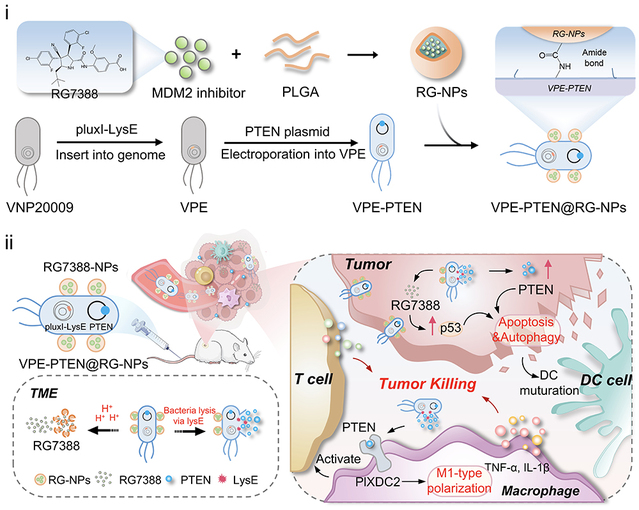
PTEN and p53 are two of the most frequently inactivated tumor suppressors in cancer. They engage in reciprocal positive regulation, forming a synergistic tumor-suppressive network. Using attenuated Salmonella typhimurium VNP20009 as the bacterial chassis, the research team employed Red/ET recombination to integrate a quorum-sensing (QS)-regulated lysis gene cassette (pluxI-LysE) into its genome. They also introduced a PTEN expression plasmid driven by the pluxI promoter, thereby generating the VPE-PTEN strain. When the bacterial density reaches a threshold, the QS circuit triggers autonomous bacterial lysis and the release of PTEN. As the density falls, lysis ceases and bacterial growth resumes, forming a negative-feedback cycle.
The team then used carbodiimide chemistry to covalently conjugate PLGA nanoparticles loaded with the MDM2 inhibitor RG7388 (RG-NPs) to the surface of VPE-PTEN, producing an engineered bacterial platform that is capable of restoring the tumor-suppressive functions of PTEN and p53. Intracellularly, the platform restores PTEN and p53 functions, thereby re-establishing the mechanisms that control tumor cell growth. Extracellularly, PTEN and the highly immunogenic components of the bacteria jointly stimulate antitumor immunity, blocking tumor progression through multiple mechanisms.
In vitro experiments showed that the extracellular-to-intracellular PTEN ratio in VPE-PTEN was approximately 5.2-fold higher than that in VNP-PTEN. VPE-PTEN also effectively inhibited the PI3K/AKT pathway, induced tumor cell apoptosis and autophagy, and promoted M1 macrophage polarization and dendritic cell maturation. In vivo, the engineered bacteria achieved a tumor inhibition rate of 94.9% in a B16F10 melanoma mouse model and also exhibited potent antitumor and antimetastatic activity in 4T1 breast cancer and LLC lung cancer models. When combined with an anti-PD-1 antibody, the platform achieved 100% mouse survival throughout the 80-day observation period in the 4T1-luc model, demonstrating pronounced antitumor efficacy. The study lays an important foundation for developing new engineered-bacteria-based strategies for cancer therapy and their clinical translation.