Recently, the College of Marine Geo-sciences at Ocean University of China (OUC) published a research article entitled “Slab thermal transitions in the Aeolian arc driven by sub-slab mantle upwelling in the early Pleistocene” online in Nature Communications. The study documented, for the first time, a rapid transition in slab thermal state in the magmatic record of the Mediterranean Aeolian arc and established a link between slab-tearing-induced upwelling of hot asthenospheric mantle and the compositional evolution of arc magmas.
The thermal state of a subducting slab profoundly influences how arc magmas form and their chemical composition. The conventional view holds that slab thermal state is controlled primarily by subduction parameters such as slab age, dip angle, and convergence rate. However, geochemical signatures consistent with slab melting have also been observed in subduction zones involving old, cold slabs. These signatures are generally attributed to slab heating by asthenospheric upwelling through slab tears or windows. Yet continuous temporal records capable of constraining the specific effects of such slab thermal perturbations on the compositional evolution of arc magmas remain lacking.
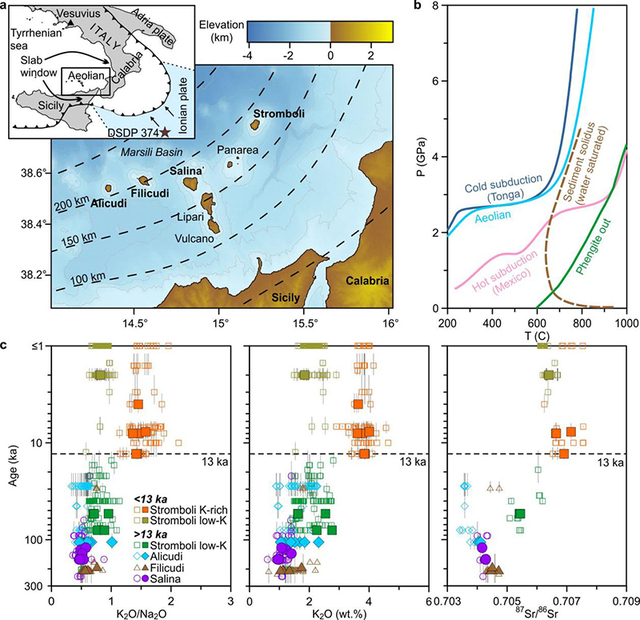
To address this question, the research team systematically analyzed the major- and trace-element and K-Sr-Nd isotopic compositions of arc volcanic rocks and subducted sediments from the Aeolian subduction zone in the Mediterranean, a representative cold subduction system. The results revealed an abrupt shift in magma composition at Stromboli volcano in the eastern Aeolian arc around 13,000 years ago: volcanic rocks erupted since then are markedly enriched in potassium (K2O/Na2O > 1 and K2O > 3 wt.%). Isotopic and trace-element evidence indicated that this potassium enrichment was not caused by shallow-level magmatic processes, such as crystal fractionation or crustal contamination, but instead reflected a fundamental shift in how subducted sediments were incorporated into the mantle source: from the incorporation of bulk sediment without significant melting under cold-slab conditions to the addition of high-temperature sediment-derived melts triggered by slab heating. In light of the regional geological setting, the team proposed that a slab-tearing event in the early Pleistocene (approximately 1-2 Ma) caused hot asthenospheric mantle to upwell from depth and directly heat the slab surface, driving a “cold-to-hot” transition from sediment dehydration to melting. This process produced a rapid geochemical response in the arc volcanic rocks on a timescale of less than 1-2 million years.
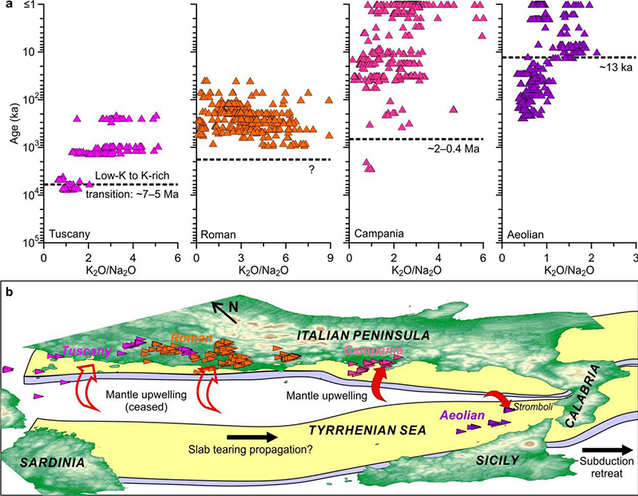
The study not only provides the first continuous record of magmatic evolution associated with slab thermal perturbation caused by asthenospheric mantle upwelling, but also reveals the southeastward propagation of slab tearing and associated asthenospheric upwelling across the Italian Peninsula. This pattern closely matches the spatiotemporal progression of the transition from low-K to K-rich magmatism across the peninsula, providing a new geodynamic perspective on the origins of recent volcanism in the region, including at Mount Vesuvius.