On June 10, a research team led by Professors Li Sanzhong and Dai Liming from the Key Laboratory of Submarine Geosciences and Prospecting Techniques of the Ministry of Education at Ocean University of China (OUC), in collaboration with teams led by Academician Zhu Rixiang and Researcher Liu Lijun from the Institute of Geology and Geophysics of the Chinese Academy of Sciences (CAS), published a research article titled “Deep mantle plume origin of oceanic intraplate volcanism” in Nature Geoscience. The study establishes a link between mantle plumes and tens of thousands of seamounts on the global seafloor.
Recent detection data show that more than 40,000 seamounts are scattered across oceanic plates worldwide covering almost all ocean basins. According to the classical hotspot hypothesis, high-temperature mantle plumes rising from the core-mantle boundary induce partial melting beneath moving tectonic plates, producing long chains of submarine volcanoes such as the Hawaiian Islands. However, only about 50 seamount chains conform to the classical hotspot model. This indicates a significant mismatch between the hotspot model and the number, scale, and spatial distribution of seamounts. A key scientific question therefore arises: Are all seamounts generated by hotspot and mantle plume activity? If so, how can such a limited number of hotspots explain the widespread occurrence of seamounts throughout the global oceans?
To date, the international research community has proposed multiple hypotheses to explain the origin of seamounts worldwide. These hypotheses mainly include sublithospheric small-scale convection, edge-driven convection, shear-driven upwelling, outer rise flexure melting, and upper-mantle upwelling or secondary plumes. However, most of these models are conceptual or simplified two-dimensional representations, and their mutual compatibility and consistency with deep mantle processes remain elusive.
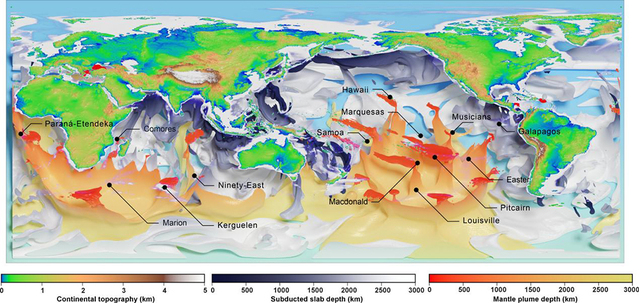
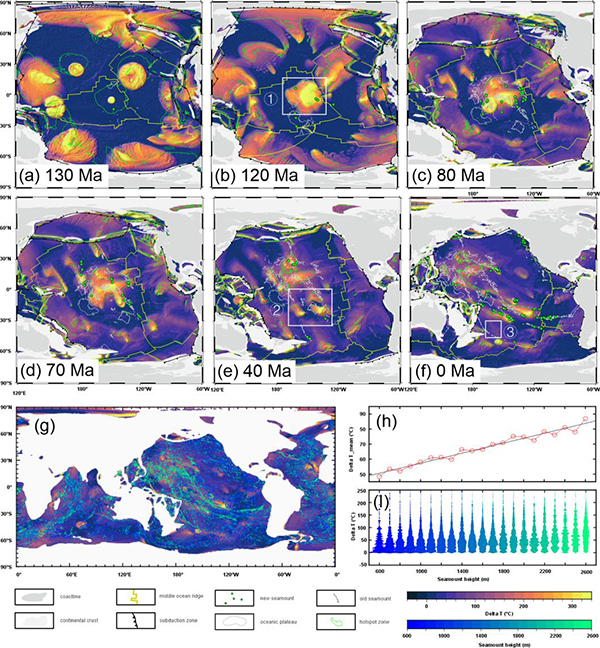
Recently, a multi-institutional research team from OUC and the CAS Institute of Geology and Geophysics, used a newly refined high-resolution global data-assimilation model to precisely reproduce the global subduction history since 270 Ma, based on the global microplate reconstruction model developed by Professor Li Sanzhong’s team at OUC. On this basis, the team simulated and analyzed the spatiotemporal evolution of global mantle plumes. The model not only reasonably reproduces the locations of most observed hotspots and the thermal structure of the asthenosphere, but also successfully predicts the spatiotemporal evolution of deep mantle plumes corresponding to key hotspots such as Hawaii. This four-dimensional model reveals that the formation and evolution of both linear, well-organized seamount chains and isolated scattered seamounts are closely associated with asthenospheric thermal anomalies generated by mantle plumes originating from the core-mantle boundary, thereby providing a unified physical framework for the origin of seamounts worldwide.
Taking the Pacific plate as an example, during the early stages of mantle plume upwelling, large amounts of plume-derived hot materials accumulated beneath the young Pacific plate, forming extensive thermal anomalies in the asthenosphere. These anomalies exhibit a clear spatiotemporal correspondence with the emergence of scattered seamounts in what is known as the West Pacific Seamount Province. During subsequent evolution, mantle plumes may split either from their lower-mantle roots or within the mantle transition zone, generating secondary mantle plumes. This process further increases the number of shallow hotspots and creates favorable conditions for the formation of additional seamount chains. These hot materials can persist within the asthenosphere over geological timescales, gradually migrating and dispersing under the influence of mantle convection. The modeled temperatures of these residual thermal anomalies show a significant linear correlation with observed seamount elevations at corresponding locations, thereby revealing that these asthenospheric thermal anomalies can generate numerous small and scattered seamounts, confirming that such thermally anomalous regions serve as “seamount brewing zones.”