On May 29, a research group led by Professor Gan Bolan from the Frontier Science Center for Deep Ocean Multispheres and Earth System at Ocean University of China (OUC) published its latest findings in Science Advances under the title “Oceanic mesoscale eddies enhance the Pacific Decadal Oscillation and its predictability.” The article was selected as a recommended article for the issue. The study proposes, for the first time, a mechanism of air-sea coupled decadal oscillation driven by oceanic mesoscale eddies, revealing the key role of oceanic mesoscale dynamics in enhancing the Pacific Decadal Oscillation (PDO) and its predictability.
The PDO is a leading mode of decadal variability in the Earth’s climate system. Its phase change has far-reaching ramifications for marine ecosystems, fisheries, and global hydroclimate, and it is also one of the key sources of near-term climate predictions. However, the physical mechanisms governing the PDO remain uncertain. Coarse-resolution climate models generally present systematic biases in simulating and predicting the PDO, particularly within the PDO core region, the Kuroshio Extension (KE) region. Over 70% of oceanic kinetic energy resides in mesoscale eddies, and they strongly modulate local air-sea heat exchange. Because satellite observations are limited in duration and coarse-resolution models cannot realistically represent mid-latitude air-sea interactions, the role of oceanic mesoscale eddies in the formation and evolution of the PDO has remained poorly understood.
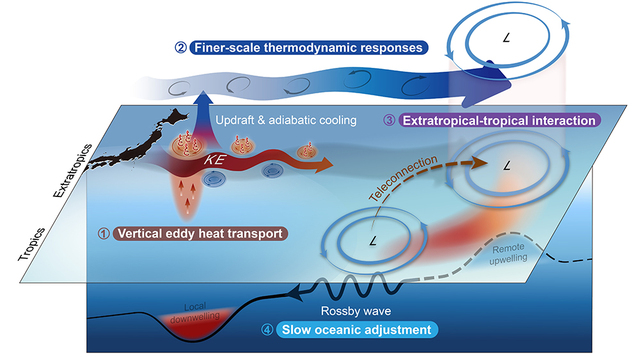
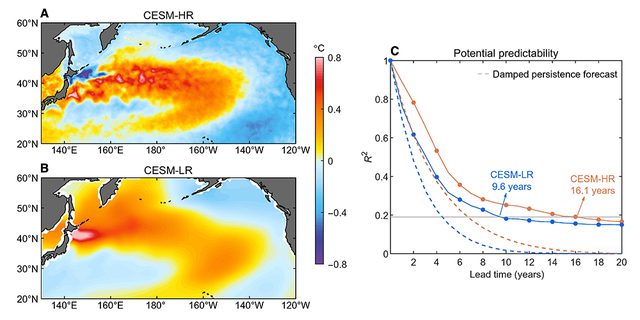
The researchers utilized an eddy-resolving configuration of the Community Earth System Model (CESM-HR) developed by the team with a nominal horizontal resolution of 0.1° ocean and 0.25° atmosphere, and carried out a unique 640-year-long preindustrial climate simulation. The study reveals the dynamical driving effect of oceanic mesoscale eddies in the KE region on the PDO through local air-sea interactions, as well as their influence on PDO predictability. Combining statistical diagnosis with a partial-coupling experiment on mesoscale ocean-atmosphere interactions, the study found that during the PDO cold phase, mesoscale warm sea surface temperature (SST) anomalies associated with the northward-shifted KE intensify the lateral diabatic heating gradient, thereby driving deep updrafts. These deep updrafts adiabatically cool the mid-troposphere, cause weakened transient eddy momentum flux there, and the resulting anomalous convergence of eddy vorticity flux facilitates the basin-scale low-pressure anomaly. The anomaly is further strengthened through extratropical-tropical interactions and induces the westward Rossby wave propagation, forming delayed negative feedback that promotes the transition of the PDO toward its warm phase. Meanwhile, mesoscale eddy-induced vertical heat transport effectively offsets the cooling effect of surface net heat flux, thereby sustaining SST anomalies and providing additional PDO memory. These coupled processes substantially extend the PDO-related SST predictability up to 16.1 years in the eddy-resolving simulation—an increase of nearly 70% relative to the conventional coarse-resolution model.
The study moves beyond the conventional view that the PDO is primarily a mid-latitude ocean response to atmosphere-dominated forcing. It points out for the first time the key role of the thermodynamic forcing of the mid-latitude atmosphere by oceanic mesoscale eddies in PDO phase transitions. This upscale effect represents a critical missing link in understanding the formation and predictability of the PDO. The findings offer a new dynamical perspective on the mechanisms of decadal climate variability and are of great scientific significance for improving decadal climate prediction.