Recently, a research team led by Professor Zheng Tianyuan from the College of Environmental Science and Engineering at Ocean University of China (OUC) made important progress in research on the dominant mechanisms of coastal aquifer salinization and the origins of seawater intrusion. The team’s latest findings were published in Science Advances under the title “Paleo–salt water dominates coastal aquifer salinization: A continental-scale study in China.” By integrating interdisciplinary approaches such as hydrogeological survey, hydrochemical analysis, and stable isotope tracing, the study identified two dominant types of coastal groundwater salinization in China, providing an important scientific basis for the protection and management of coastal groundwater resources in the country.
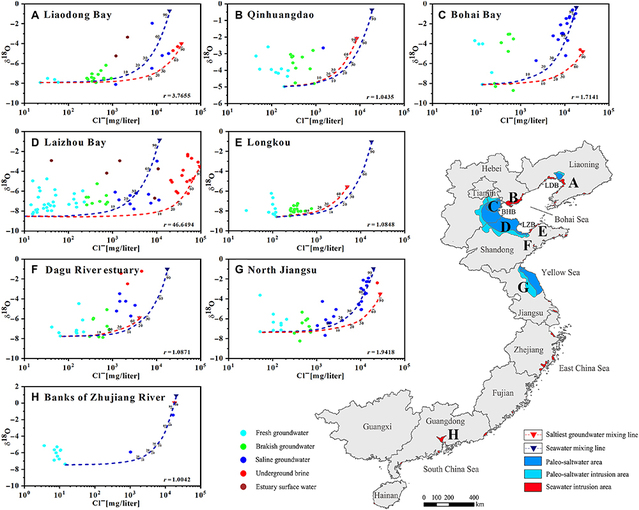
This study systematically collected and analyzed data from more than 2,100 groundwater samples across China’s coastal regions at a national scale, and integrated hydrogeological surveys with multi-isotope tracing to reconstruct the dominant mechanisms of coastal groundwater salinization in China. It confirms, for the first time, that paleo-saltwater intrusion affects 66% of the observed salinized areas, whereas modern seawater intrusion affects about 34%. The study reveals a cascading mechanism in which geological structures define the fundamental framework that controls intrusion patterns, meteorological and hydrological factors shape its pathways, and human groundwater extraction accelerates the rate and expands the extent of seawater intrusion. The findings provide direct reference for groundwater management in similar sedimentary basins worldwide and represent an important milestone in revising conventional understanding and optimizing prevention and control strategies.