Recently, a research team led by Professor Liu Licheng at the College of Chemistry and Chemical Engineering in Ocean University of China (OUC) made new progress in photocatalytic CO2 reduction. The findings were published in Angewandte Chemie International Edition in a research article entitled “Reconfigurable Charge Transfer between Type-II and Z-Scheme in WO3/Cu2O for All-day Photoreduction of CO2.”

Against the backdrop of the global energy transition and China’s “dual carbon” goals, the solar-driven conversion of CO2 into value-added products has emerged as an important pathway toward circular carbon utilization. However, conventional photocatalytic systems rely heavily on continuous irradiation, and their catalytic reactions are generally difficult to sustain at night or under low-light conditions, limiting the practical application of photocatalytic CO2 reduction. Designing a catalyst that can continuously drive CO2 reduction in the dark is therefore essential to overcome the dependence on continuous illumination in photocatalysis.
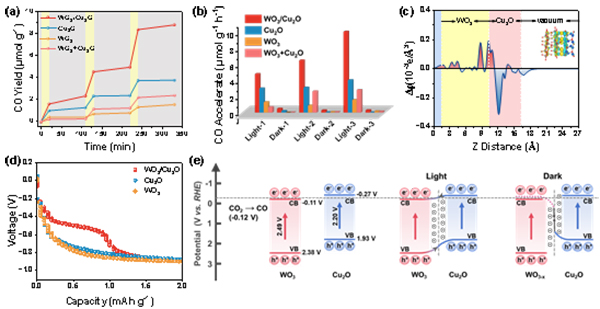
To address this challenge, the team designed a WO3/Cu2O heterostructured photocatalyst capable of dynamically regulating charge transfer. The researchers found that the heterostructure could reversibly reconfigure its charge-transfer pathway under alternating light and dark conditions. Under illumination, the system exhibited a Type-II charge-transfer pathway, driving electrons from Cu2O to WO3 and reducing some W6+ species to W5+. Electrons accumulated until a dynamic equilibrium was reached, yielding WO3-x/Cu2O. In darkness, electrons stored in WO3-x were gradually released and back-transferred to the heterointerface, where they recombined with residual holes in the valence band of Cu2O. Consequently, the carrier-transport pathway switched to a Z-scheme pathway. This dynamic charge-transfer process integrates light-induced charging, dark discharge, and round-the-clock catalytic conversion, offering a new design principle for photocatalytic systems operating under intermittent illumination. The study highlights the important role of dynamic charge reconfiguration within heterostructures in regulating solar-driven catalytic processes. It also establishes a new photocatalytic strategy based on electron storage and release, providing a theoretical basis and materials-design guidance for developing efficient, stable solar-driven CO2 conversion systems that can continue to operate under dark conditions.