Recently, a research team led by Professor Zhang Zhengguang at the Frontiers Science Center for Deep Ocean Multispheres and Earth System, Ocean University of China (OUC), made new progress in research on oceanic submesoscale processes and tropical cyclones (TCs). The findings were published online in Proceedings of the National Academy of Sciences in a research article entitled “Weak prestorm submesoscale sea surface temperature gradients conducive to tropical cyclone intensification.” The study, for the first time, revealed a new mechanism by which prestorm submesoscale sea surface temperature gradients (SSTGs) modulate TC-induced sea surface cooling and subsequent variations in TC intensity, thereby establishing a mechanistic link between oceanic submesoscale processes and TCs, a typical type of extreme atmospheric event.
The ocean is a major energy source for TC formation and intensification. As a TC passes over the ocean, its powerful winds drive vertical mixing and cold-water entrainment in the upper ocean, bringing cold subsurface water to the surface and producing pronounced sea surface cooling. This cooling, in turn, reduces heat transfer from the ocean to the atmosphere, thereby exerting a negative feedback on TC intensity. Previous studies have focused primarily on how vertical thermodynamic conditions, such as mixed layer depth, thermocline structure, and upper-ocean heat content, modulate this process. However, the real ocean is not horizontally homogeneous. Submesoscale SSTGs with horizontal scales ranging from approximately 1 kilometer to several tens of kilometers are ubiquitous in the ocean, yet their effects on TCs were previously unknown.
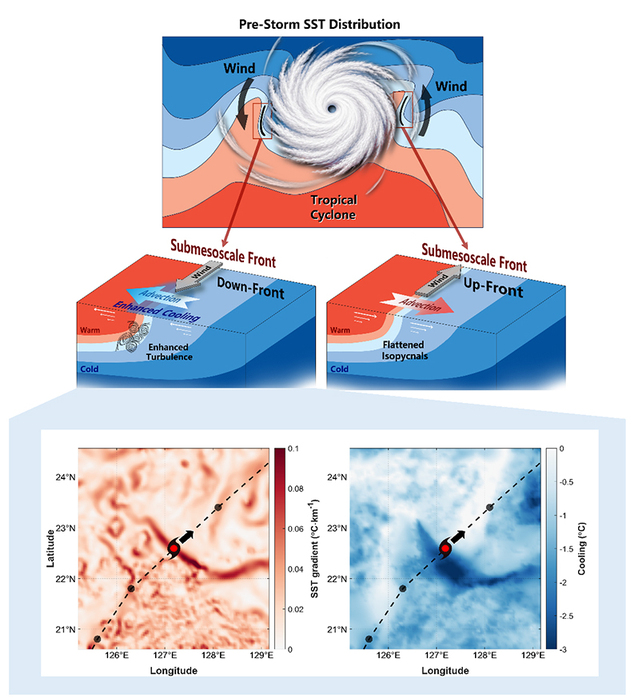
Combining multiple observational datasets, including global high-resolution satellite remote-sensing data and surface drifter observations, the research team systematically examined the relationships among prestorm submesoscale SSTGs, TC-induced sea surface cooling, and subsequent changes in TC intensity. The results showed that, under the combined influence of SSTGs and down-front winds, cross-front transport pushes cold, dense seawater toward the warm side of the front, destabilizing the upper ocean and enhancing vertical turbulent mixing and the entrainment of cold subsurface water, thereby amplifying sea surface cooling. Weaker SSTGs diminish this additional frontal cooling effect, allowing the sea surface to remain warmer and continue supplying more energy to TCs.
Aggregated globally, weak SSTGs favor TC intensification and lead to approximately 40% higher TC intensity than that over strong SSTGs. Approximately 70% of rapidly intensifying intense TCs occur over weak SSTGs, and approximately 60% of intense landfalling TCs experience below-average SSTGs in the days preceding landfall. The globally averaged number of fatalities from landfalling TCs experiencing weak prestorm SSTGs is approximately 50% higher than that associated with TCs experiencing strong SSTGs. In addition, a decreasing trend of approximately 10% per decade on average in prestorm SSTGs has been observed across all TC-active regions since 1993. In a warming climate, this trend may weaken TC-induced sea surface cooling and the associated negative feedback on TC intensity, thereby creating more favorable oceanic conditions for TCs to reach higher intensities. These findings suggest that prestorm submesoscale SSTGs could serve as a potential oceanic indicator for predicting intense TCs and the risk of rapid intensification.