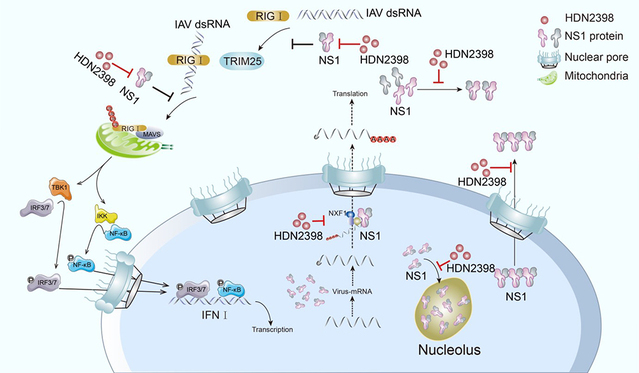
Recently, research teams led by Professors Wang Wei and Li Dehai at the School of Medicine and Pharmacy of Ocean University of China (OUC) made significant progress in research on marine-derived anti-influenza agents through a joint research effort. The findings were published in Nature Communications in an article entitled “Identifying a broad-spectrum influenza inhibitor that blocks multiple functions of viral NS1 protein.”
Influenza A virus (IAV) nonstructural protein 1 (NS1) promotes viral replication and antagonizes interferon responses through interactions with host factors. As a key determinant of IAV pathogenicity and host adaptation, it has emerged as a promising target for anti-influenza drug development. Building on the team’s earlier discovery that marine alkaloids can exert anti-influenza effects by targeting viral hemagglutinin (J. Med. Chem., 2020, 2026), the researchers screened compounds using in vitro and in vivo models and identified HDN2398, a marine-derived indole alkaloid derivative with potent, broad-spectrum anti-IAV activity both in vitro and in vivo. HDN2398 did not inhibit viral entry or viral RNA synthesis but attenuated the interferon-antagonistic activity of NS1, suggesting that NS1 might be its target. In addition, oral administration of HDN2398 significantly reduced pulmonary viral titers, increased survival in mice, and alleviated lung inflammation, showing greater overall efficacy than oseltamivir. These findings suggest that HDN2398 has the potential to be developed as a novel anti-influenza agent.
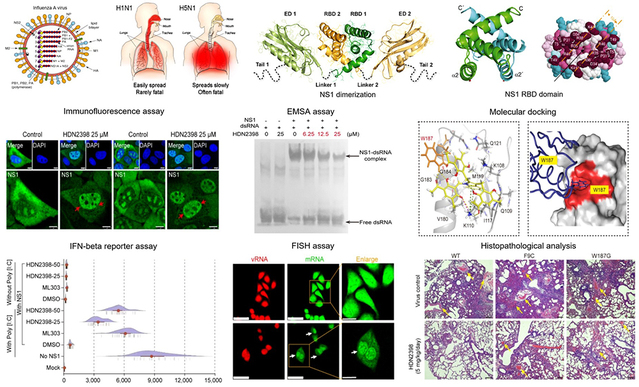
The research team further conducted a systematic investigation into the molecular mechanisms underlying the anti-IAV activity of HDN2398. The results showed that HDN2398 bound directly to NS1 and disrupted the interaction between NS1 and nucleolin, thereby interfering with the nucleolar localization of NS1. It also inhibited the interaction between NS1 and NXF1, reducing the nuclear export of viral mRNA and NS1. In addition, HDN2398 weakened the ability of NS1 to promote viral mRNA splicing by blocking its interaction with NS1-BP. By blocking the binding of NS1 to dsRNA and TRIM25, HDN2398 restored activation of the RIG-I/MAVS signaling pathway and thereby promoted interferon production. Molecular docking, escape mutant screening, and reverse-genetics experiments indicated that Trp187 and Phe9 are key NS1 residues required for HDN2398 binding and that the compound inhibited NS1 oligomerization and its interferon-antagonistic activity. By disrupting multiple functions of NS1, HDN2398 inhibited IAV infection and replication. In summary, the study not only provides a basis for developing novel anti-influenza drugs targeting NS1 but also offers a new strategy for developing broad-spectrum antiviral drugs that target virus-host interactions.