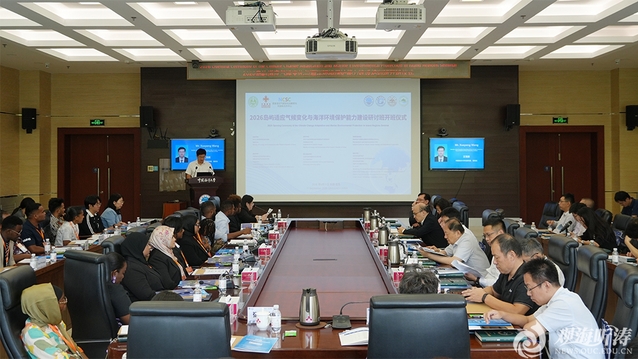
On September 11, the Ministry of Ecology and Environment’s 2026 Climate Change Adaptation and Marine Environmental Protection in Island Regions Seminar opened at the Laoshan Campus of Ocean University of China (OUC).
Lu Xinming, Deputy Director General of the Department of Climate Change, Ministry of Ecology and Environment, noted that climate change poses a serious challenge to all humanity. China is firmly committed to implementing its national strategy of actively addressing climate change and continues to provide assistance within its capacity to developing countries through South-South cooperation on climate change. Drawing on Qingdao’s strengths as a hub for marine science and technology and one of China’s first pilot cities for carbon peaking, the seminar focused on the core needs of island countries and promoted mutual learning. He expressed the hope that participants would benefit from the seminar and wished it every success.
Ding Anhui, Deputy Director-General of the Qingdao Municipal Foreign Affairs Office, briefly introduced Qingdao and its exchanges and cooperation with island countries. He noted that this year marked the fourth year of the program in Qingdao and that the seminar was jointly hosted by OUC and Shandong University, with the program’s influence continuing to grow. The Qingdao Municipal Foreign Affairs Office will continue to promote closer friendly exchanges between Qingdao and other island countries and support cooperation between the two universities in marine and climate change-related fields.
Wang Xuepeng, Vice President of OUC, gave an overview of OUC and reviewed its achievements in hosting the Ministry of Ecology and Environment’s Capacity Building Program for South-South Cooperation on Climate Change for four consecutive years. He noted that OUC would further leverage its disciplinary strengths and resource advantages, focus on capacity building for climate change adaptation and marine environmental protection, work with all parties to strengthen exchanges and cooperation, and jointly make greater contributions to building a maritime community with a shared future.
Li Shengying, Vice President of Shandong University (Qingdao), described the seminar as a constructive effort to put into practice the vision of a community with a shared future for humanity. He expressed confidence that mutual learning and multilateral dialogue would further strengthen all parties’ overall capacity to address climate change, and looked forward to building on the seminar to make substantive contributions to achieving global carbon neutrality goals and building a better future for humanity.
Under the theme “Climate Change Adaptation and Marine Environmental Protection in Island Regions,” the seminar offered 17 themed courses, complemented by field visits and cultural activities, to participants from 13 island countries, with the aim of further strengthening their capacity for climate change adaptation and marine environmental protection.