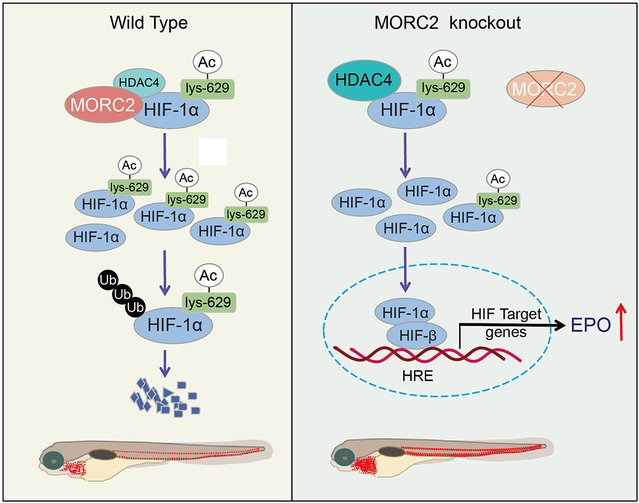
Recently, a joint research team led by Professors Lu Ling and Hao Jiejie of the School of Medicine and Pharmacy, Ocean University of China (OUC), made new progress in adaptation to hypoxia and the regulation of erythrocyte homeostasis. The findings were published in PNAS (Proceedings of the National Academy of Sciences of the United States of America) in an article entitled “MORC2 controls HIF-1α stability via an HDAC4-dependent mechanism to regulate erythropoiesis.” Focusing on the Microrchidia family CW-type zinc-finger 2 (MORC2), the study established MORC2 as a novel key regulator of the HIF signaling pathway, thereby providing an important theoretical basis for elucidating the pathogenesis of hypoxia-related conditions such as erythrocytosis and cardiovascular and cerebrovascular diseases, as well as for exploring potential targeted therapies.
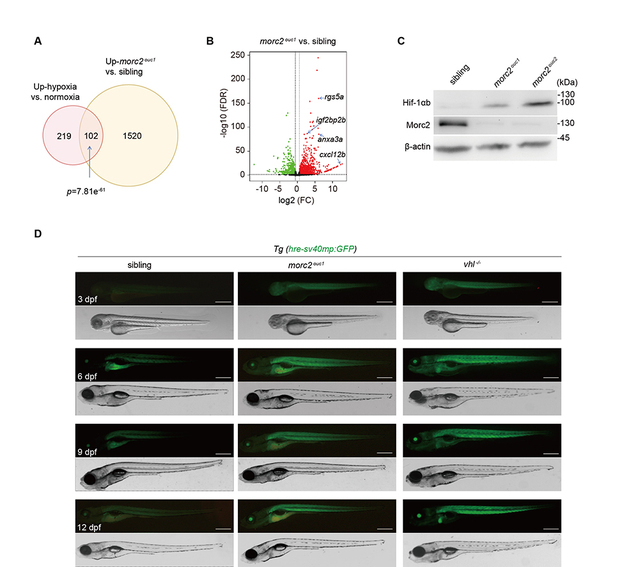
The researchers first generated morc2-mutant zebrafish and found that the mutants developed polycythemia and increased heart rate, with pericardial edema and cardiac dilation. These phenotypes closely resembled those observed under hypoxia and in vhl-deficient zebrafish, suggesting activation of the HIF signaling pathway. Transcriptome sequencing showed that loss of morc2 upregulated downstream target genes of the HIF pathway and elevated Hif-1αb protein levels. The researchers then crossed the mutants with the transgenic hypoxia-responsive fluorescent reporter zebrafish line, Tg(hre-sv40mp:GFP). Under normoxic conditions, the morc2 mutants exhibited strong GFP fluorescence comparable to that observed in vhl-deficient zebrafish used as a positive control, providing clear evidence that MORC2 functions as a negative regulator of the HIF signaling pathway.
In vitro experiments further showed that the loss of MORC2 markedly increased the protein levels of both HIF-1α and HIF-2α, resulting in sustained activation of the HIF signaling pathway and increased secretion of the downstream effectors erythropoietin (EPO) and vascular endothelial growth factor A (VEGFA). Conversely, ectopic overexpression of MORC2 markedly suppressed HIF-1α-dependent transcriptional activity. Mechanistic studies of the negative regulation of HIF signaling by MORC2 revealed that MORC2 and HDAC4 compete for binding to HIF-1α. MORC2 knockout enhanced HDAC4 recruitment to HIF-1α, thereby reducing acetylation of HIF-1α at lysine 629 (K629), preventing its proteasomal degradation, and leading to sustained activation of the HIF pathway. Rescue experiments further showed that pharmacological inhibition of HDAC4 and genetic knockdown of hdac4 counteracted the effects of morc2 deficiency in zebrafish, suppressing aberrant HIF pathway activation and reversing the erythrocytosis phenotype.