Recently, a research team led by Professor Zhang Shaoqing at the Frontiers Science Center for Deep Ocean Multispheres and Earth System, Ocean University of China (OUC), in collaboration with research teams in China and abroad, has made new progress in research on the global ocean meridional overturning circulation (GMOC). Based on two independently developed coupled data assimilation systems and the coupled reanalysis datasets they generated, the study revealed that volcanic eruptions over the past 80 years have left a profound imprint on the GMOC, thereby influencing climate variability for decades afterward. The findings were published online in Nature Communications in an article entitled “The Coupled Reanalysis Global Meridional Overturning Circulation Imprinted by Historic Volcano Eruptions.”
The global ocean meridional overturning circulation (GMOC) is the primary “conveyor belt” for the global circulation of matter and energy between the upper and deep layers of the ocean and between tropical and polar regions. Numerous studies have shown that the GMOC has important effects on climate at both global and regional scales. However, a comprehensive picture of its historical evolution remains vague due to limitations in modelling and observing systems. Incorporating atmospheric and oceanic observations into coupled Earth system models offers a viable approach to reconstructing climate history. However, reconstructing the GMOC remains challenging, as it requires models to reproduce vertical ocean motion, which is closely tied to the ocean’s overall vertical stratification. The lack of deep-ocean observations and model biases in deep-ocean simulations make it extremely difficult to reproduce ocean stratification consistent with its historical evolution, creating a critical bottleneck in reconstructing the history of the GMOC.
To overcome this bottleneck, the team first addressed the lack of direct observations against which to validate the spatial structure and temporal variability of the GMOC by developing two independent coupled data assimilation (CDA) systems for cross-validation. This allowed the researchers to assess and constrain uncertainties in the coupled reanalyses. They then developed a multiscale CDA algorithm incorporating a climatological relaxation scheme. By assimilating atmospheric and oceanic observations from 1945 onwards, they produced two 80-year coupled reanalysis datasets that capture the coordinated evolution of multiple components of Earth’s climate system and quantitatively assessed their ability to reconstruct the GMOC. The results show that ocean stratification in the two coupled reanalyses closely agreed with each other and was consistent with observations. The reconstructed mean-state structure and temporal variability of the GMOC also clearly captured its historical evolution. Further tracing of signal-propagation pathways across different components of the Earth system revealed that radiative forcings from historical volcanic eruptions could cause significant changes in the GMOC. The 1991 eruption of Mt. Pinatubo, for example, cooled the North Atlantic, intensified deep convection in the region, and consequently induced a GMOC anomaly that persisted for decades.
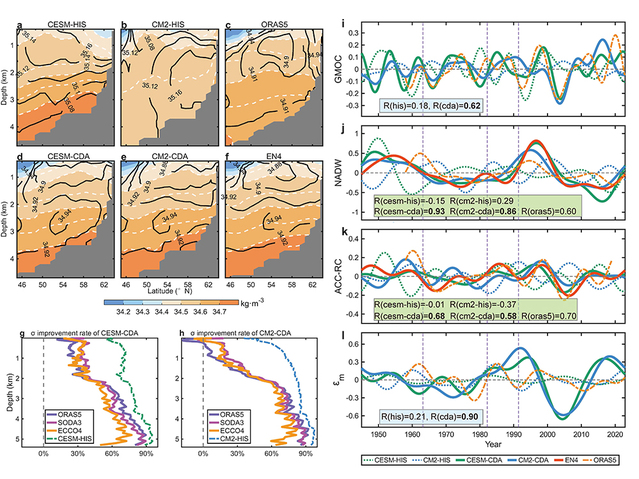
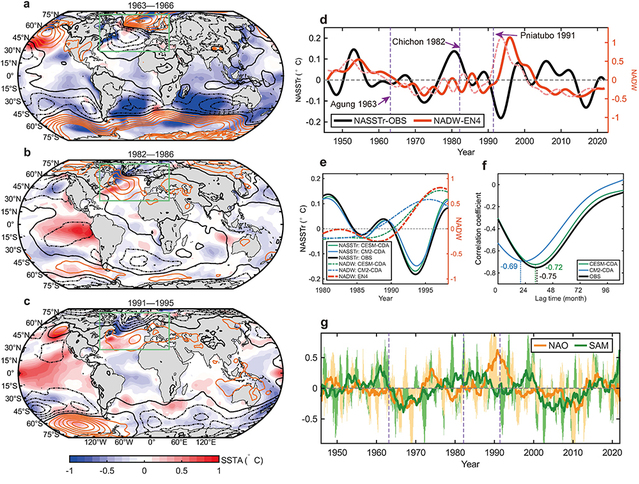
The study examined the covariability between the GMOC and its associated physical modes, further revealing interactions among the overturning branches in the North Atlantic, the tropical oceans, and the Southern Ocean, which are dominated, respectively, by North Atlantic Deep Water (NADW), tropical diffusive mixing, and the Antarctic Circumpolar Current residual circulation. By constraining the wind field, the multiscale CDA algorithm developed in this study substantially improved simulations of wind-driven circulation in the Southern Ocean. By assimilating the subsurface temperature and salinity observations and constraining deep-ocean biases, it also improved the representation of diapycnal mixing in the North Atlantic and tropical oceans. These improvements greatly enhanced the ability to simulate overturning variability in the Southern Ocean, the tropical oceans, and the North Atlantic, thereby substantially improving the representation of major historical events such as volcanic eruptions in the reconstructed GMOC. The two coupled reanalyses were able to reproduce the global sea surface temperature cooling signals associated with three major volcanic eruptions in the second half of the 20th century. The combined cooling effects of the 1982 Mt. El Chichón and 1991 Mt. Pinatubo eruptions produced an exceptionally strong decadal-scale cold anomaly in North Atlantic sea surface temperature (SST). After a lag of roughly two to three years associated with vertical transport, this anomaly led to a pronounced strengthening of NADW, which in turn had a substantial effect on the multidecadal variability of the GMOC.
The study further examined the responses of atmospheric circulation and sea surface buoyancy fluxes, showing that different volcanic events affect the GMOC through different mechanisms. It identified the North Atlantic Oscillation (NAO) and the Southern Annular Mode (SAM) as key background modes of atmospheric circulation that regulate the strength of the GMOC response to volcanic eruptions. The 1991 eruption of Mt. Pinatubo coincided with a strongly positive NAO phase, providing a favorable circulation background and substantially intensifying deep convection in the North Atlantic, which produced the most pronounced GMOC response. During the 1963 eruption of Mt. Agung, by contrast, both the NAO and SAM were in negative phases, and the combined suppressive effects of the two circulation modes substantially weakened NADW formation. From an oceanic-dynamics perspective, the radiative effects of volcanic aerosols can regulate the onset and evolution of deep convection at high latitudes by perturbing the North Atlantic sea surface buoyancy flux and altering the strength of regional diapycnal mixing, ultimately affecting the multidecadal variability of the GMOC.
Using coupled data assimilation and reanalysis techniques, the study examined the evolution of the GMOC and its associated physical modes across multiple timescales. Focusing on major volcanic eruptions as a form of external forcing, it explored their possible effects on multidecadal changes in the GMOC. The findings help advance understanding of multiscale processes within the climate system. Tracing signals across different components of the Earth system also provides a new perspective on the predictability of extreme climate events.