Recently, a research team led by Professor Song Fengfei at the Frontier Science Center for Deep Ocean Multispheres and Earth System, Ocean University of China (OUC), made new progress in research on long-term changes in surface solar radiation. The findings were published in National Science Review (NSR) in an article entitled “Polar dimming and mid-latitude brightening in a warming climate.” The study found that changes in downward surface solar radiation under global warming exhibit a pronounced spatial and seasonal pattern characterized by polar dimming and mid-latitude brightening, which is most prominent in the local summer.
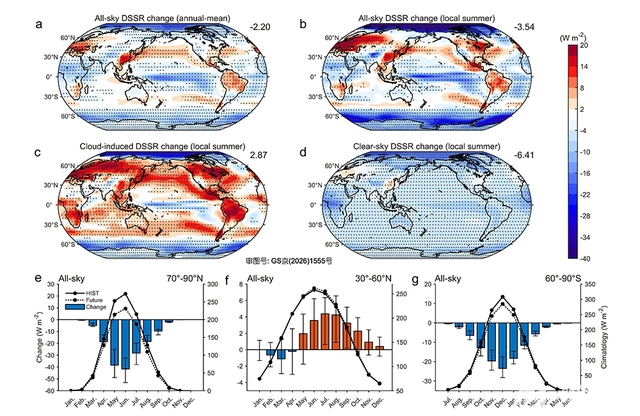
Downward surface solar radiation (DSSR) is a fundamental component of the Earth’s surface energy budget. It not only regulates surface temperature, evaporation, and snow and ice melting, but is also a key factor affecting variations in solar energy resources. Previous studies have shown that global-mean DSSR is projected to continue declining under high-emission scenarios. Regional and seasonal variations in DSSR, however, are more consequential than its global-mean change. Using climate models, the research team revealed the spatial pattern of DSSR changes under global warming. The results showed that by the end of the 21st century, DSSR would not decline uniformly across the globe but would instead exhibit a pronounced meridional contrast: it would decrease markedly in the polar regions (dimming), while increasing in the Northern Hemisphere (NH) mid-latitudes (brightening). This pattern of polar dimming and mid-latitude brightening is most prominent in the local summer.
Further decomposition of the DSSR response showed that clear-sky DSSR generally decreases across most of the globe, mainly because increased atmospheric water vapor under global warming enhances the absorption of solar radiation. By contrast, cloud-induced DSSR changes exhibit pronounced regional differences and are the key factor behind the opposing changes in polar and mid-latitude regions. In the polar regions, the increase in cloud liquid water path (LWP) enhances the reflection of solar radiation by clouds. The cloud-induced and clear-sky effects therefore act together to drive polar dimming. At NH mid-latitudes, however, cloud-induced brightening competes with clear-sky dimming. The cloud-induced brightening dominates, ultimately producing mid-latitude brightening. These DSSR changes occur primarily in the local summer when the climatological DSSR is the largest. Consequently, the amplitude of the DSSR seasonal cycle changes significantly: it decreases by 14.6% in the Arctic and 7.0% in the Antarctic but increases by 2.1% at NH mid-latitudes.
Notably, the pattern of polar dimming and mid-latitude brightening is not confined to the high-emission scenario; it also occurs under medium- and low-emission scenarios. Satellite observations over the past two decades have captured a similar signal, indicating that the spatial pattern of DSSR changes is relatively robust and that its effects may already be emerging amid ongoing climate change. The study provides an important scientific basis for understanding changes in the Earth’s surface energy budget under global warming, climate responses in polar and mid-latitude regions, and future changes in solar energy resources.