Recently, a research team led by Professor Liu Weizhi at the Fang Zongxi Center for Marine Evo-Devo, Ocean University of China (OUC), made new progress in the self-assembly of marine adhesive proteins. To address the diversity of underwater adhesion strategies used by marine organisms and the elusive Dopa-independent self-assembly mechanisms of adhesive proteins, the team collaborated with researchers from City University of Hong Kong and the Shanghai Advanced Research Institute, Chinese Academy of Sciences. By integrating insights from biophysics, computational biology, and materials sciences, the researchers elucidated, at multiple scales, new mechanisms by which Dopa-independent marine adhesive proteins achieve robust underwater adsorption. The researchers found that disulfide bonds can act as “covalent stickers” that drive the hierarchical self-assembly of marine adhesive proteins, while tyrosine functions like a “molecular zipper” to mediate rapid underwater adsorption. The related findings were published in Advanced Science, a multidisciplinary journal, and Acta Biomaterialia, a leading journal in biomaterials.
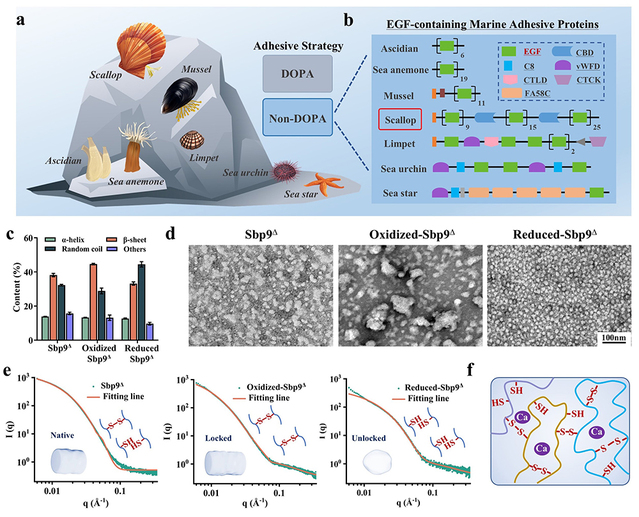
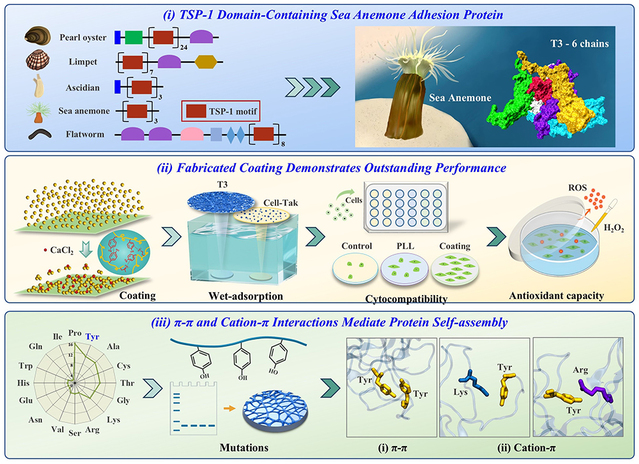
The marine adhesive protein Sbp9Δ is rich in cysteine, and its self-assembly relies on the finely tuned interplay between disulfide bonds and Ca2+ coordination. Using techniques from biophysics and materials science, the research team found that Ca2+ acts as an assembly trigger, while dynamic disulfide bonds function as “covalent stickers,” locking the initially flexible, random-coil protein conformation into a rigid, β-sheet-rich rod-like structure and thereby enabling ordered assembly. For the tyrosine-rich marine adhesive protein TSRL, molecular dynamics simulations revealed that tyrosine residues function as a “molecular zipper” via π-π and cation-π interactions, thereby mediating ordered inter-chain aggregation. Following mutation of key amino acid residues, the protein’s self-assembly capacity and underwater adhesion strength decreased significantly. By integrating multidisciplinary methods, the researchers elucidated at the molecular level the mechanism by which TSRL achieves underwater adsorption.
These studies help improve our understanding of the adaptive strategies used by marine organisms for underwater adhesion and provide new ideas for developing high-performance, stable bioinspired materials for wet adhesion.