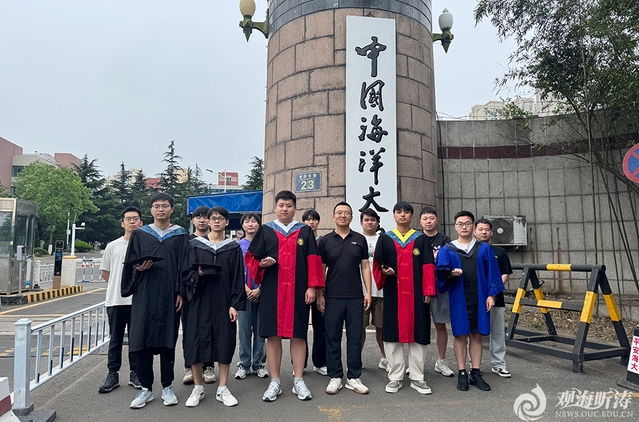
On July 13, a research team led by Professor Ren Weiwu from the School of Medicine and Pharmacy of Ocean University of China (OUC) made new progress in the asymmetric total synthesis of marine polycyclic cembrane norditerpenoid natural products. The findings were published in an article entitled “Asymmetric Total Synthesis of (+)-Ineleganolide” in Angewandte Chemie International Edition.
The structural complexity and diversity of natural products, together with the specificity of their biological activities, underpin their distinctive scientific value and make them an important driving force in drug discovery and development, innovation in synthesis strategies, and life sciences research. Polycyclic cembrane diterpenoids and norditerpenoids are important marine natural products with soft corals as the primary source. Characterized by highly oxidized, structurally intricate polycyclic frameworks and notable anti-tumor pharmacological activities, these compounds have attracted sustained and intense interest from synthetic chemists over the past three decades.
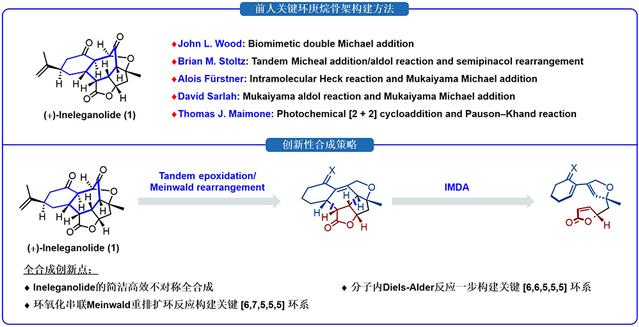
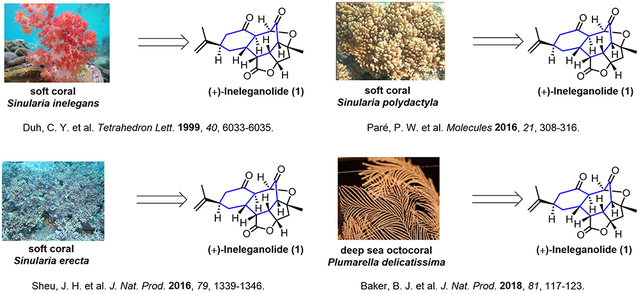
Ineleganolide is one of the most representative members of this natural-product family. It was first isolated from the soft coral Sinularia inelegans in 1999 and was subsequently isolated by several other research groups. Bioactivity studies have shown that it exhibits potent cytotoxicity against P-388 murine leukemia cell lines. Structurally, ineleganolide features a highly rigid oxidized [6,7,5,5,5] cage-type pentacyclic scaffold with pronounced ring strain, incorporating nine chiral centers, eight of which are contiguous, making stereochemical control exceptionally difficult and presenting a formidable synthetic challenge.
To address the unique architecture of the molecule, the team devised a novel asymmetric synthesis strategy. First, they used an intramolecular Diels–Alder reaction to assemble the core [6,6,5,5,5] pentacyclic scaffold in a single step. Taking advantage of the high ring strain inherent to the central cyclohexane unit, sequential epoxidation/Meinwald rearrangement was employed to achieve ring expansion, thus efficiently affording the sterically congested cycloheptane skeleton. With this innovative synthesis strategy, the team completed a concise and efficient asymmetric total synthesis of (+)-ineleganolide in a longest linear sequence of just 13 steps.
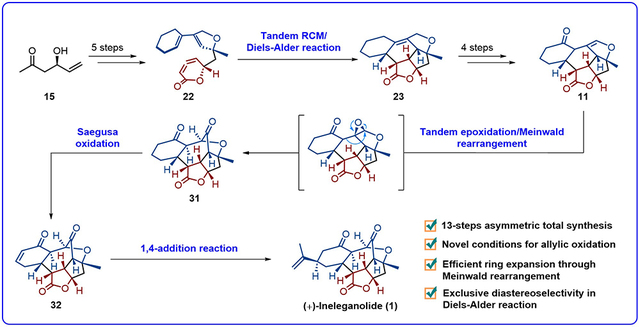
The team’s synthetic endeavors commenced with commercially available chiral allylic alcohol 15. They prepared key precursor 22 in five steps via a one-pot selectiveTBS protection/ propargylzinc addition sequence, gold-catalyzed cyclization, introduction of an OTf froup, Suzuki cross-coupling, and ester condensation. A subsequent tandem ring-closing metathesis (RCM)/intramolecular Diels–Alder reaction constructed the [6,6,5,5,5] fused pentacyclic core and furnished intermediate 23. It was then converted into precursor 10 in four steps comprising a one-pot sequential Riley and Ley oxidations, selective allylic oxidation, reduction, and elimination. A tandem epoxidation/Meinwald rearrangement afforded key substrate 31. Finally, Saegusa oxidation followed by a 1,4-addition completed the asymmetric total synthesis of (+)-ineleganolide.
This concise and efficient route comprises only 13 linear steps. The tandem RCM/intramolecular Diels–Alder cycloaddition and the tandem epoxidation/Meinwald rearrangement each furnished a single stereoisomeric product. The route not only enables the efficient preparation of the target molecule but also provides the material needed for systematic studies of the drug-development potential of the marine cembrane norditerpenoid natural-product family.