The heart is one of the key evolutionary innovations in the rise of complex animal life. For a long time, heart research has focused predominantly on a small number of model organisms, such as zebrafish and mice, as well as humans themselves, while little is known about arthropods, mollusks, protochordates, and other groups that collectively account for the vast majority of the animal kingdom. In fact, non-model animals that occupy key nodes across the tree of life encompass a rich array of transitional heart forms, ranging from simple tubular structures to complex chambered organs.Moreover, many of these lineages harbor remarkable cardiac regenerative capacities, making them uniquely valuable for research. However, constrained by technical and methodological bottlenecks in studying the hearts of non-model species, questions regarding the cellular and molecular basis of cardiac diversity, its evolutionary origins, and the patterns of convergent and divergent evolution across phyla have remained unresolved to this day.
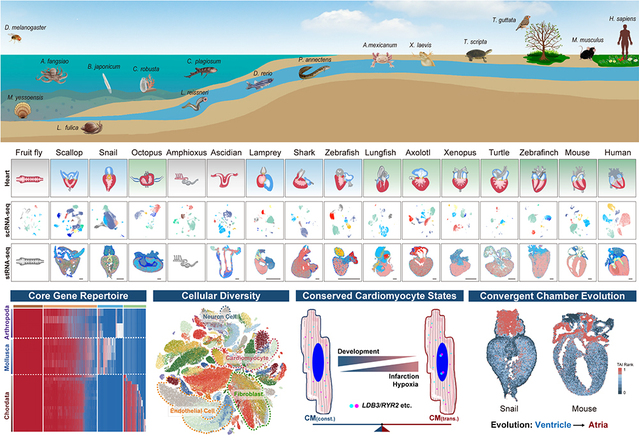
To overcome these challenges, the joint research team profiled adult hearts from 27 representative bilaterian species across four dimensions: comparative genomics, bulk transcriptomics, single-cell transcriptomics, and spatial transcriptomics. Through integrative analysis, they constructed a comprehensive molecular evolutionary atlas of animal hearts, revealing their macroevolutionary trajectory. Spanning both protostomes and deuterostomes, the study covered tubular, two-chambered, three-chambered, and four-chambered heart morphologies, with samples from aquatic, amphibious, and terrestrial animals. This study contributes the most taxonomically comprehensive and evolutionarily broad adult heart multi-omics transcriptomic dataset to date, and establishes an open-access database, HEART (https://db.genomics.cn/stomics/heart/), offering the scientific community a key resource and platform for animal heart research.
The study reveals that the molecular blueprint of the animal “proto-heart” can be traced back to the bilaterian ancestor, following a macroevolutionary strategy in which a core gene repertoire was progressively expanded and innovated upon. Cardiomyocytes, fibroblasts, endothelial cells, and neural cells constitute the four conserved cellular cornerstones of the bilaterian “proto-heart,” while the genetic remodeling of cardiomyocytes is a key factor in the adaptation of animal hearts during the transition from aquatic to terrestrial environments. Based on spatially resolved single-cell atlas, the researchers identified a class of cross-species conserved transient-state cardiomyocytes involved in cardiac development and responses to injury or hypoxic stress. They also systematically characterized conserved molecular signatures of the atria and ventricles across protostomes and deuterostomes, and revealed that the molecular similarity between tubular-heart cardiomyocytes and ventricular cardiomyocytes is stronger than their similarity to atrial cardiomyocytes in both lineages, leading to ventricle-first model of atrioventricular chamber evolution The study not only provides novel insights into the origin and macro-evolution of the heart but also offers an important reference for deciphering the genetic basis of the heart and for clinical medical research.