Recently, a research group led by Associate Professor Wang Nan within Professor Bao Xianwen’s team at the College of Oceanic and Atmospheric Sciences, Ocean University of China (OUC), collaborated with researchers from the National Marine Hazard Mitigation Service, Ministry of Natural Resources, and other institutions in China and abroad, published their latest findings in an article entitled “National restoration initiatives promote China’s marine ecosystem recovery” in Communications Earth & Environment, a Nature Portfolio journal.
In this study, the researchers developed the marine ecological restoration effectiveness (MERE) index, an innovative framework for cross-regional, multi-ecosystem assessment, and used it to evaluate, for the first time at the national scale, the overall effectiveness of marine ecological restoration projects spanning multiple regions and ecosystem types. The results demonstrated that China’s systematic, government-led approach to marine ecological restoration has been highly effective, delivering simultaneous gains in habitat recovery, carbon sequestration capacity, and economic value. The study provides a transferable assessment methodology and offers China’s experience as a useful reference for marine ecological restoration worldwide.
Under the combined pressures of human activities and climate change, coastal ecosystems worldwide are undergoing widespread degradation, and marine ecological restoration has become an important means of addressing these challenges. However, cross-regional, multi-ecosystem marine restoration initiatives comprise numerous geographically dispersed and functionally interconnected restoration units. Traditional indicators designed for project-scale assessments are poorly suited to evaluating national restoration initiatives as a whole, while monitoring data are often difficult to obtain. Together, these constraints create a methodological bottleneck for comprehensive assessments of restoration effectiveness at national and even global scales.
Since 2016, China has implemented a series of marine ecological restoration initiatives, including the Blue Bay Comprehensive Remediation Action and the Coastal Zone Protection and Restoration Projects. These initiatives represent important practical efforts to implement Xi Jinping Thought on Ecological Civilization and advance China’s dual-carbon goals. As restoration efforts have expanded in duration and geographic scope, the lack of methods for comprehensively assessing restoration effectiveness across regions has increasingly constrained the development of science-based restoration. Accordingly, the Ecological and Environmental Code of the People’s Republic of China, China’s 15th Five-Year Plan, and the guiding principles of the sixth meeting of the Central Commission for Financial and Economic Affairs all explicitly call for intensified efforts to comprehensively assess ecological restoration effectiveness.
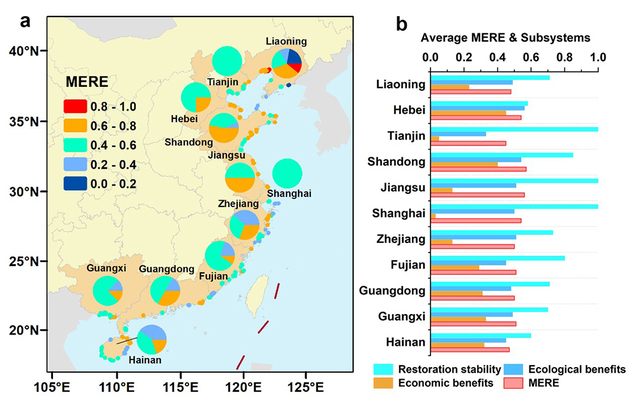
To address this major national need, the team used the 81 national-level marine ecological protection and restoration projects implemented in China between 2016 and 2022 as a case study. Combining remote-sensing analysis with machine learning, the team applied random forest classification to 10-m-resolution Sentinel-2 imagery to generate land-cover and coastline-type datasets for the prerestoration (2015) and postrestoration (2023) periods. On this basis, they developed an assessment framework encompassing three dimensions: restoration stability, ecological benefits, and economic benefits. Indicator weights were determined using the analytic hierarchy process, and the robustness of the index was tested using metrics including mean absolute deviation, mean rank shift, and correlation coefficients.
The results showed that, through the implementation of the 81 national restoration projects, 15,423 ha of salt marshes were recovered, accounting for 23.99% of the total salt march area lost over the 27-year period from 1984 to 2011; 3,238 ha of mangroves were restored, offsetting 14.23% of the total mangrove area lost over the 65-year period from 1950 to 2015; and 275.47 km of degraded natural coastlines were restored, equivalent to 6.74% of the total natural coastline loss over the 25-year period from 1990 to 2015.
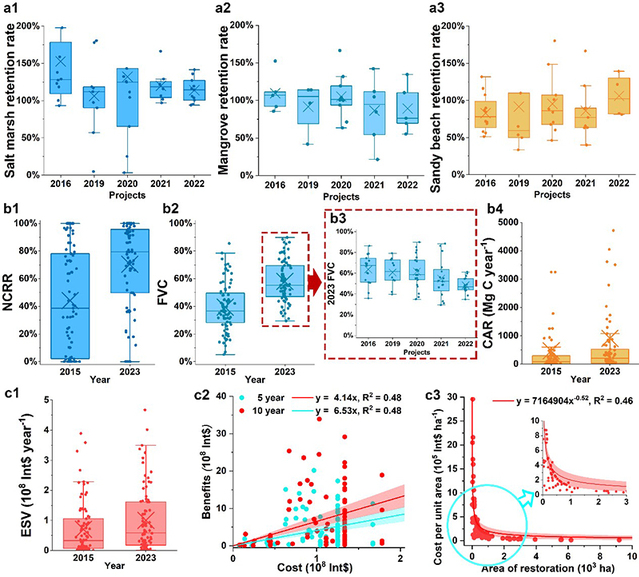
Across the 81 restoration areas, the median natural coastline retention rate (NCRR) doubled, rising from 38.62% in 2015 to 79.44% in 2023, as fragmented artificial coastlines were gradually transformed into continuous natural coastlines. The median fractional vegetation cover (FVC) also increased significantly, from 36.58% to 55.29%. The community structures of mangrove and salt-marsh vegetation continued to recover, with active restoration beginning to facilitate natural recovery. Blue carbon storage and sequestration capacity increased substantially: the total carbon accumulation rate across the restoration areas rose by 94.85%, reaching approximately 73,400 metric tons of carbon per year. Socioeconomic benefits also increased significantly, with the total ecosystem service value of the restoration areas rising by 41.71% to approximately 29.6 billion RMB per year.
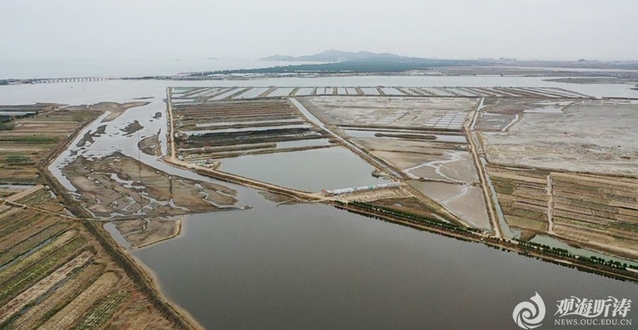

National-level restoration projects, however, represent only the tip of the iceberg of China’s restoration efforts. Numerous restoration initiatives undertaken by local governments, enterprises, and non-profit organizations have yet to be captured in the available statistics. Together, these initiatives will help advance habitat restoration and sustainable development in China.
This study overcomes a key methodological bottleneck by providing a reproducible and transferable framework, built on accessible data and robust indicators, for comprehensively assessing cross-regional, multi-ecosystem marine ecological restoration. Application of the framework to China’s national restoration initiatives demonstrated that the country’s systematic, government-led approach to marine ecological restoration has been highly effective, delivering simultaneous gains in habitat recovery, carbon sequestration capacity, and economic value. The study not only helps address a major national strategic need but also offers China’s experience as a useful reference for marine ecological restoration worldwide.