Recently, a research team led by Professor Jiang Zhaoxia of the Key Laboratory of Submarine Geosciences and Prospecting Techniques, Ministry of Education, at Ocean University of China (OUC), published a research article entitled “Equatorial Indian Ocean productivity over the last 200,000 years and links to deep circulation variations” online in Communications Earth & Environment, a Nature Portfolio journal.
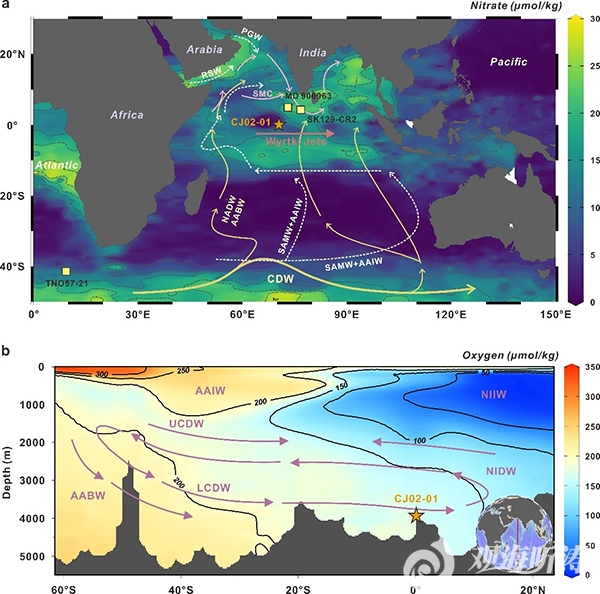
Ocean circulation and the biological pump (BP) are crucial mechanisms that regulate variations in atmospheric carbon dioxide (CO2) levels during Quaternary glacial-interglacial cycles. The deep ocean is the largest carbon reservoir on Earth. Exchanges between deep waters and the surface ocean not only regulate the upward transport of nutrients and marine productivity, but may also influence the release of deep-ocean carbon into the atmosphere. The equatorial Indian Ocean is situated mid-way along the global ocean circulation system, receiving deep waters originating from the Southern Ocean and contributing to global oceanic exchanges of matter and energy through upwelling and mixing. However, compared with regions such as the Southern Ocean and the North Pacific, the equatorial Indian Ocean has relatively few high-quality, continuous records. How deep circulation affects nutrient supply to the upper ocean and variations in productivity therefore requires further investigation.
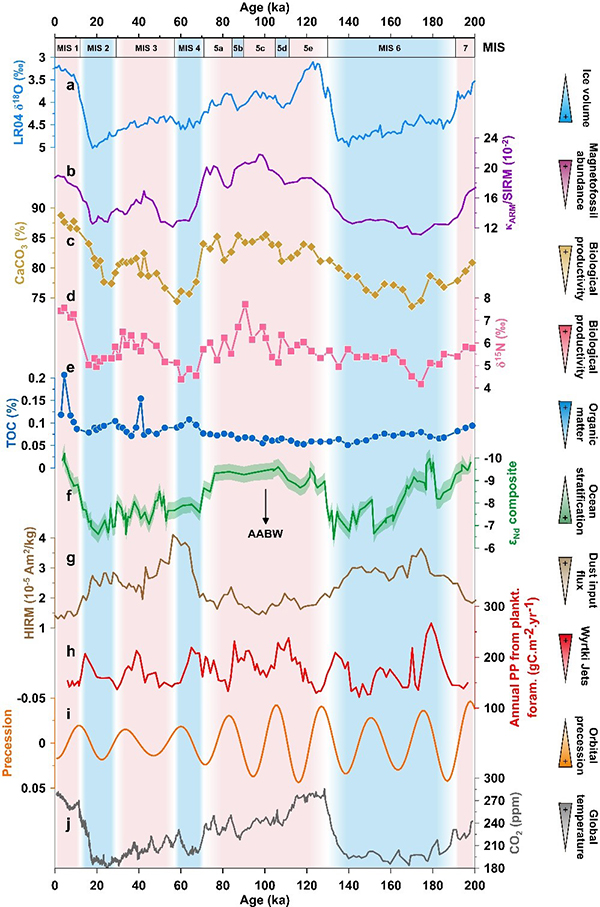
To address this question, the researchers conducted systematic environmental magnetic, rock-magnetic, and geochemical analyses of sediment core CJ02-01, recovered from the eastern slope of the Central Indian Ridge in the western equatorial Indian Ocean at a water depth of 3580 m. The study used nanoscale magnetofossils formed by biomineralization of magnetotactic bacteria and preserved in sediments as a key proxy, identifying and quantifying variations in their abundance. Magnetofossil abundance was generally higher during warm periods and lower during cold periods, and showed good agreement with independent productivity proxies such as calcium carbonate (CaCO3)content and sedimentary nitrogen isotope (δ¹⁵N) values. These results indicate that magnetofossil abundance can serve as an effective indicator of long-term variations in biological productivity in this region.
Based on these findings, the team further examined three potential controls on productivity variations in the equatorial Indian Ocean: regional surface winds, external iron input, and deep circulation. Comparisons showed that the productivity variations recorded in CJ02-01 could not be attributed to the upper-ocean vertical mixing driven by stronger equatorial westerlies. In addition, magnetofossil abundance was negatively correlated with hard isothermal remanent magnetization (HIRM). Aeolian dust input from the Arabian Peninsula increased during glacial periods, suggesting that natural aeolian iron fertilization played only a limited role in regulating glacial-interglacial productivity variations in this region. By contrast, magnetofossil abundance and other productivity records showed good agreement with changes in Indian Ocean deep-water masses, indicating that basin-wide deep circulations may be the dominant control on productivity variations in the equatorial Indian Ocean.
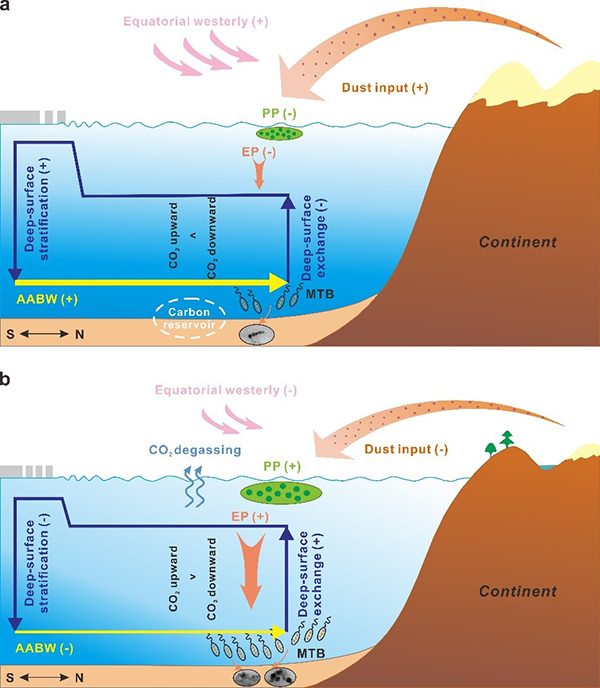
Semi-quantitative water mass fraction estimates based on authigenic neodymium (Nd) isotope compositions (εNd) indicate that variations in deep circulation in the equatorial Indian Ocean were closely linked to the northward transport of Antarctic Bottom Water (AABW) from the Southern Ocean. During glacial periods, AABW expanded into the deep Indian Ocean basins, strengthening deep-ocean vertical stratification and creating a physical barrier that inhibited the upward transport of nutrient-rich deep-water. This reduced nutrient supply to surface waters and lowered biological productivity in the equatorial Indian Ocean. Meanwhile, stronger deep-ocean stratification and weaker deep-surface exchange favored carbon storage in the deep ocean and suppressed the release of deep-ocean carbon dioxide into the atmosphere. During warm interglacial periods, the influence of AABW weakened, reducing water-column stratification in the equatorial Indian Ocean and strengthening exchange between the deep and surface ocean. Nutrient-rich deep water could therefore be transported more readily into the euphotic zone, enhancing surface-ocean biological productivity and the export of organic carbon to the seafloor. Stronger deep-surface exchange may also have facilitated the release of carbon dioxide previously sequestered in the deep ocean, first into surface waters and subsequently into the atmosphere. This study provides new sedimentological and environmental magnetic evidence to understand changes in the ocean carbon reservoir across Pleistocene glacial-interglacial cycles and cross-latitudinal climatic linkages between the Southern and Indian Oceans.