On July 3, a research team led by Professor Dong Shuanglin of the Key Laboratory of Mariculture of the Ministry of Education, Ocean University of China (OUC) published a research article entitled “Synergistic effect of abalone and macroalgae on carbon storage in a co-culture ecosystem” on Communications Earth & Environment under the Springer Nature portfolio.
Abalone is an economically important herbivorous gastropod. In 2022, global farmed abalone production exceeded 200,000 metric tons, with an output value of 2 billion dollars. Abalone monoculture releases carbon dioxide (CO₂) into seawater through respiration and bio-calcification, whereas macroalgae absorb CO₂. However, the implications of abalone-macroalgae co-culture systems for global climate change remain unclear. To address this, Professor Dong Shuanglin’s team employed manipulative mesocosm experiments to investigate the carbon storage potential and underlying mechanisms of abalone monoculture, macroalgae monoculture, and abalone-macroalgae co-culture systems.
The results showed that abalone monoculture contributes to rising atmospheric CO₂ levels. According to this study, 2.43 g CO₂ is released to the atmosphere for every gram of protein produced in monoculture system. However, once the abalone-macroalgae co-culture is implemented, an additional 1.46 g atmospheric CO₂ could be absorbed per gram protein produced. Acting as a green “carbon vacuum cleaner,” macroalgae not only absorb the CO₂ released by abalone but also use the nitrogen and phosphorus excreted by abalone as natural fertilizers, fueling their own rapid growth. In this way, abalone waste is turned into a resource by macroalgae.
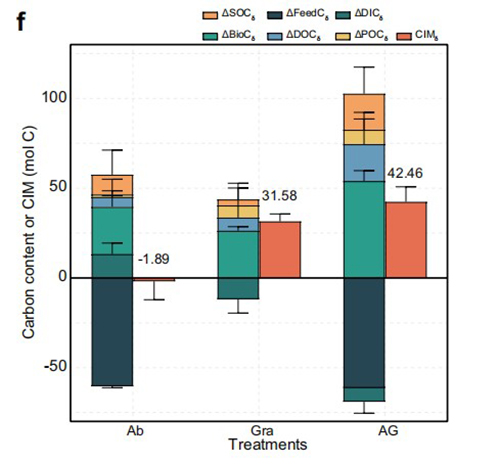
Together, abalone and macroalgae form a “golden partnership” that produces a remarkable “1+1>2” synergistic effect. The carbon storage rates of the abalone monoculture and macroalgae (Gracilaria lemaneiformis) monoculture systems were–3.78 mg C/d/m2 and 63.16 mg C/d/m2, respectively, yielding a theoretical combined rate of 59.38 mg C/d/m2. In practice, however, the abalone-macroalgae co-culture system achieved a carbon storage rate of 84.92 mg C/d/m2, 1.43 times the theoretical combined rate. This synergistic effect is driven by two mechanisms: 1) well-balanced “nutrient competition.” In the abalone monoculture system, nitrogen, phosphorus, and other nutrients excreted by abalone stimulate excessive microalgal growth, inducing self-shading and reduced net community production. In the abalone-macroalgae co-culture system, competition for nutrients between macroalgae and microalgae prevents microalgal self-shading, significantly increasing the system’s overall net community production and carbon storage. 2) an enhanced biological carbon pump. Abalone-macroalgae co-culture strengthens the biological carbon pump within the system, converting more labile sedimentary organic carbon into recalcitrant organic carbon and thereby facilitating its long-term sequestration.
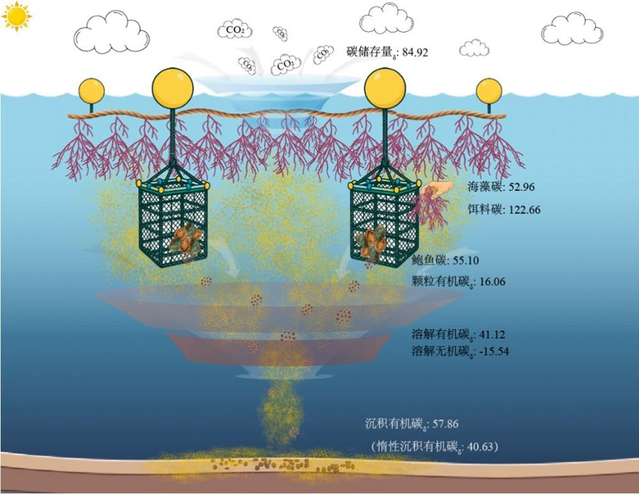
In marine abalone-macroalgae co-culture systems, macroalgae serve both as feed for abalone and as competitors with microalgae for nutrients, creating a win-win outcome for abalone protein production and carbon storage. This study demonstrates the carbon storage potential of abalone-macroalgae co-culture, further facilitating the understanding of the marine carbon cycle.