On July 8, the National Science and Technology Award Conference was held in Beijing. President Xi Jinping presented awards to the winners of the State Preeminent Science and Technology Award and delivered an important speech. Ocean University of China (OUC) won two 2025 State Science and Technology Awards, including one Second Prize of the State Technological Invention Award as a leading institution, and one Second Prize of the State Scientific and Technological Progress Award as a participating institution. Professor Jia Yonggang of OUC was invited to attend the conference in Beijing and went on stage to receive the award.
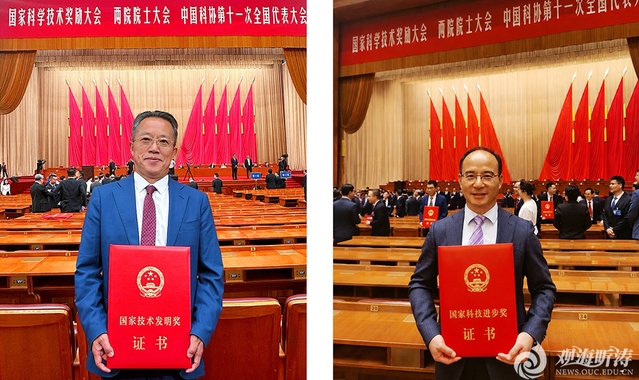
The project “In-situ Observation Technologies and Equipment for the Engineering Geological Environment of Deep-sea Mineral Development,” with Professor Jia Yonggang from the College of Environmental Science and Engineering as the first completer, won the Second Prize of the 2025 State Technological Invention Award. It is the first project in China’s deep-sea mining environmental field to win a State Science and Technology Award, demonstrating OUC’s remarkable progress in strengthening original and leading marine science and technology research.
The project “Independent R&D and Industrialization of Large-scale Deep and Far-sea Aquaculture Equipment,” with OUC as a major participating institution and Professor Liu Guijie from the College of Engineering as the second completer, won the Second Prize of the State Scientific and Technological Progress Award.
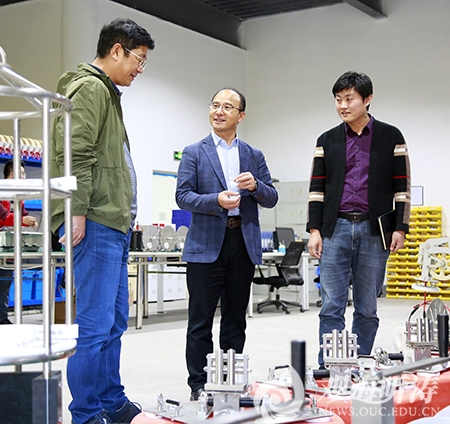
Since the start of the 14th Five-Year Plan period, OUC has won five State Science and Technology Awards, including three as the leading completing institution, making outstanding contributions to boosting China’s maritime strength.
International deep-sea mineral development is a major national strategic need, and environmental impact is a key bottleneck that constrains deep-sea mining. The engineering geological properties of deep-sea sediments, as well as their deterioration under mining disturbance, directly determine environmental impacts. However, conventional methods can hardly achieve precise, long-term, in-situ observation of the deep-sea engineering geological environment.
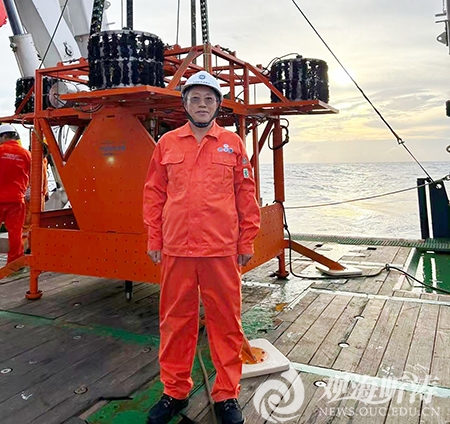
With the support from multiple national funding projects, the research team led by Professor Jia Yonggang has worked with multiple enterprises and research institutes for more than ten years. They developed original technologies for precise in-situ testing of the mechanical properties of deep-sea ultra-soft sediments, long-term in-situ observation of the deterioration process of sediment engineering properties, and long-term observation of environmental changes at the bottom water-sediment interface. The team also developed the world’s first full-ocean-depth in-situ testing equipment for the mechanical properties of sediments, long-term in-situ observation equipment for the deterioration of deep-sea sediment engineering properties, and long-term in-situ observation equipment for the benthic boundary layer environment. These achievements addressed long-standing international challenges in accurately testing the mechanical properties of deep-sea ultra-soft sediments, clearly observing the deterioration process of sediment engineering properties, and understanding environmental changes in the benthic boundary layer. They also realized, for the first time, full-chain integrated in-situ observation covering “sediment mechanical properties in mining areas—degradation during mining—environmental effects on the seabed.”
The achievements have been applied in China’s Pacific polymetallic nodule contract area. They supported the submission of China’s first environmental report for a mining test to the International Seabed Authority, safeguarding China’s rights and interests in the development of mineral resources in the international seabed area. They have also been extended to geological environmental protection and disaster prevention and control in gas hydrate production in the South China Sea and offshore oil and gas development, generating major social, environmental, and economic benefits.