Recently, a research team led by Professor Li Sanzhong from the Key Laboratory of Submarine Geosciences and Prospecting Techniques of the Ministry of Education at Ocean University of China (OUC), in collaboration with the EarthByte Group at the University of Sydney, published a research article entitled “Recurrent super highlands since 2.1 Ga reveal rhythmic coupling between deep Earth and surface evolution” online in Geology.
Continental elevation records interactions between deep Earth dynamics and surface processes, exerting profound influences on climate, marine chemistry, weathering and erosion, and the evolution of life. However, how continental elevation evolved over Earth’s long geological history—especially whether Earth once developed continental-scale highlands comparable to the modern Tibetan Plateau and Cordilleran orogenic systems, and which mechanisms controlled their formation—has long lacked globally consistent, internally coherent quantitative constraints.
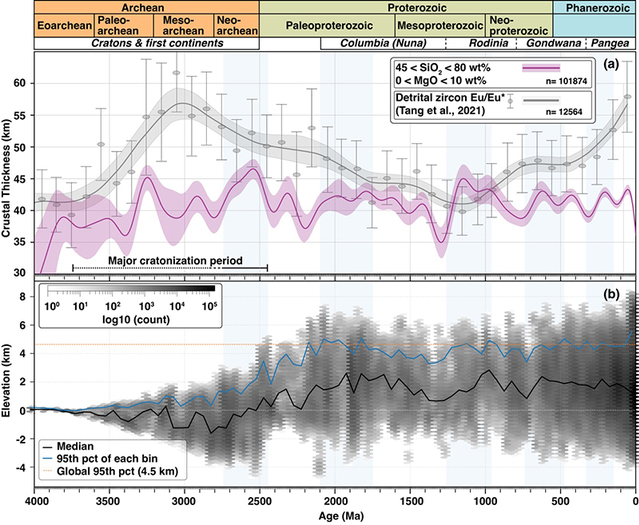
The research team integrated more than 100,000 rigorously screened and corrected igneous-rock geochemical samples with machine learning-derived paleo-crustal thickness estimates and an isostatic model that accounts for temporal changes in mantle and crustal densities. On this basis, the team reconstructed, for the first time, the paleo-elevation history of tectonically active continental regions worldwide over the past 4 billion years. The spatial organization of elevation was characterized using DBSCAN clustering to identify laterally continuous orogenic systems.
The results show that, for much of the Archean, continents remained largely below sea level and gradually emerged during the Neoarchean. Since ca. 2.1 Ga, extreme elevations (represented by the 95th percentile) have repeatedly exceeded the Tibetan Plateau-level threshold (approximately 4.5 km), forming laterally extensive, continental-scale orogenic systems that could extend for more than 2,000 km. These systems broadly coincided with the assembly stages of major supercontinents, including Columbia (Nuna), Rodinia, Gondwana, and Pangea. In contrast, the Mesoproterozoic was characterized by persistently low-relief topography and weak orogenic clustering, reflecting slow plate convergence and inefficient crustal thickening. This is consistent with a hotter and mechanically weaker lithospheric state, as indicated by the elevated metamorphic temperature/pressure ratios and massif-type anorthosite magmatism during this period. Following the breakup of the Rodinia supercontinent, extreme elevations became more persistent, which is consistent with a colder, mechanically stronger lithosphere and a more efficient convergent regime.
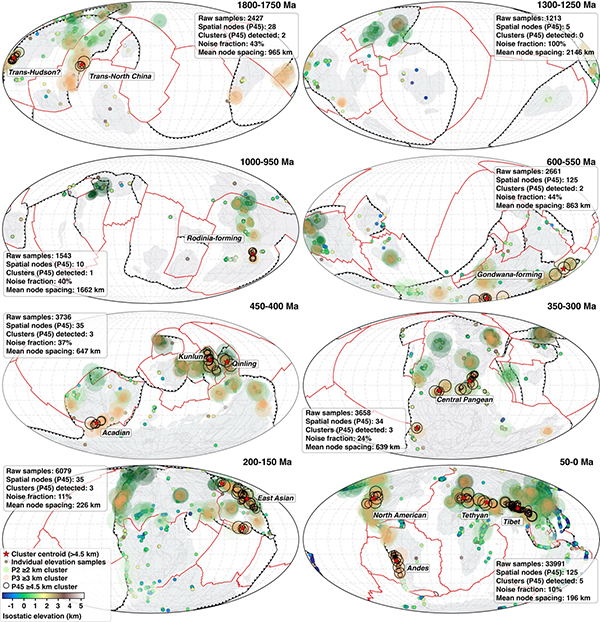
The study reveals that laterally extensive orogenic super highlands have recurred since the Paleoproterozoic, and that their formation was jointly controlled by the coupled evolution of plate kinematics and lithospheric strength. The Mesoproterozoic marks a key transition toward a colder tectonic regime with a stronger lithosphere. This configuration laid the foundation for modern orogenesis and linked the thermal evolution of the deep Earth with long-term surface topography through rhythmic deep Earth-surface coupling.