Recently, the article “From History to Literature: Re-examining the Ancient Chinese Biographical Tradition and Its Modern Transformation,” written by Professor Xiong Ming of the College of Liberal Arts, Journalism and Communication at Ocean University of China (OUC), was reprinted in full in Issue 12, 2026 of Xinhua Digest.
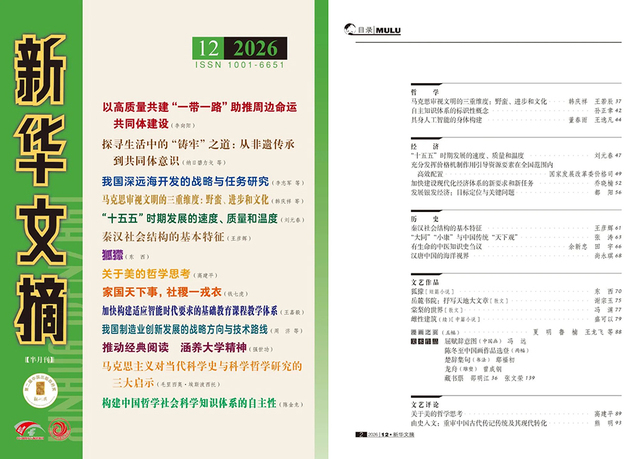
Focusing on the historical process, identity and attributes, basic forms, and modern transformation of the ancient Chinese biographical tradition, the article systematically examines the origin, development, and evolution of China’s biographical tradition. It points out that ancient Chinese biography grew out of an incipient biographical consciousness in pre-Qin texts, completed the creation of its textual system and the establishment of its writing paradigm in Shiji (Records of the Grand Historian), and gradually formed a basic pattern with liezhuan, or biographical chapters in standard histories, and zazhuan, or miscellaneous biographies, developed in parallel. As an important literary form in the traditional Chinese academic system, biography was long classified under the category of history and thus had a clear historical identity. At the same time, however, it always possessed the dual attributes of historical writing and literary expression.
The article further reveals that, after the mid-Tang period, miscellaneous biographies gradually diverged into two different paths of development: historical-category biographies, which emphasized the authenticity of historical materials and historical writing, and literary-category biographies, which promoted the transformation of biographical writing from a historical form into a literary form through more essay-like writing. The creative use of the biographical form by Han Yu, Liu Zongyuan, and others enabled biography to move beyond the scope of purely historical writing and gave rise to a flourishing tradition of biographical prose. The divergence between historical-category biographies and literary-category biographies not only constitutes a distinctive phenomenon in the development of ancient Chinese biography but also marks an important stage of biography’s shift from a historical form to a literary form.
On the basis of its examination of the modern transformation of ancient Chinese biography, the article points out that, since the modern era, Liang Qichao drew on Western biographical forms and integrated them with the Chinese biographical tradition, thereby creating a paradigm for modern critical biography. Through the theoretical advocacy and writing practices of scholars such as Hu Shi and Zhu Dongrun, biography gradually acquired a modern literary identity and ultimately completed its transformation from traditional biography to modern biographical literature. Based on a comprehensive review of China’s biographical tradition and theoretical resources, the article argues that research should move beyond the long-standing paradigm that treats biography as subordinate to either history or literature. It calls for a renewed understanding of the theoretical connotations and disciplinary value of biography from the independent perspective of its “biographical nature,” so as to promote the construction of a theoretical system of biographical studies with Chinese characteristics and provide a new academic perspective and theoretical support for the construction of China’s independent knowledge system and the creative transformation and innovative development of fine traditional Chinese culture.