On June 16, a research team led by Professor Li Sanzhong from the Key Laboratory of Submarine Geosciences and Prospecting Techniques of the Ministry of Education at Ocean University of China (OUC) published a research article entitled “Vigorous mantle convection triggered the Cretaceous Pacific large igneous provinces” online in Nature Geoscience, and was invited to contribute to the “Behind the paper” column and share the research experience behind the article.
Large igneous provinces (LIPs) record the rapid release of material and energy from Earth’s interior and are thought to be closely associated with major environmental anomalies such as abrupt global climate change and ocean anoxic events. On the Pacific seafloor, LIPs cover nearly 6 million square kilometers, including the Ontong Java Plateau, the largest volcanic event since the Phanerozoic, as well as Shatsky Rise and Hess Rise. These LIPs were predominantly emplaced during the Early Cretaceous and coincided with global anomalies such as the Cretaceous Normal Superchron, a sea-level highstand, and oceanic anoxic events. The deep geodynamic origin of this intense magmatism has long remained debated, with proposed explanations including superplume activity, accelerated subduction, and plume-ridge interaction.
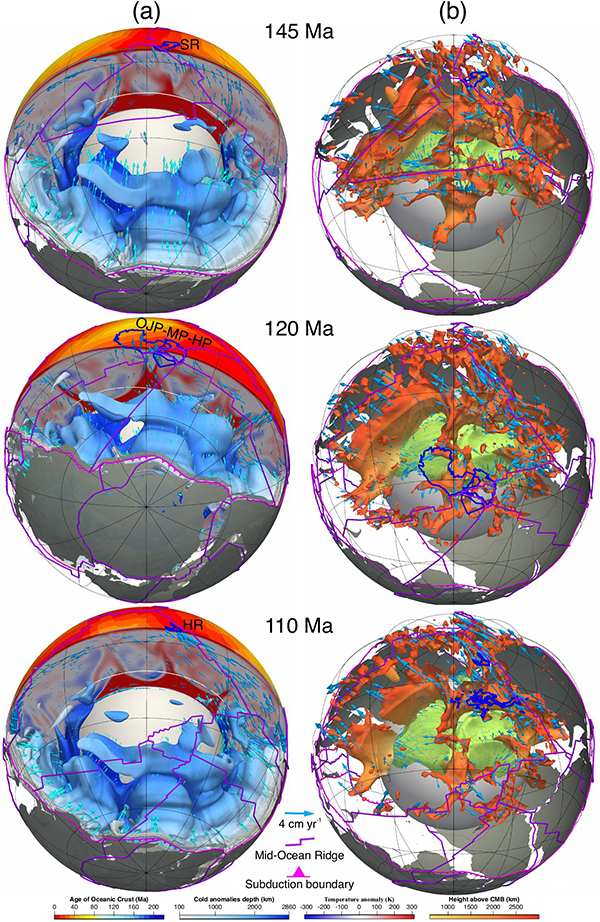
To address this important scientific question, the research team developed whole-mantle flow models with boundary conditions derived from plate reconstructions, integrating subduction history, deep-mantle large low-shear-velocity provinces (LLSVPs), mantle plume activity, and mid-ocean ridge evolution into a unified geodynamic framework. On this basis, they quantitatively characterized the spatiotemporal evolution of hot mantle upwelling intensity in the Pacific over the past 200 million years. The results show that relatively stable hot upwellings persisted in the central Pacific between ~165 and 80 Ma, rooted above the lower-mantle LLSVPs. Circum-Pacific subduction flux peaked around 130–125 Ma, rapidly increasing dynamic pressure in the lower mantle beneath the circum-Pacific subduction girdle. This induced faster convergent mantle flow toward the Pacific LLSVP regions and reinforced upper-mantle hot upwellings around the region, broadly coinciding with the peak LIP eruptions. Meanwhile, migrating spreading ridges successively intersected these hot upwellings between ~145 and 120 Ma, facilitating large-scale decompression melting and triggered concentrated LIP eruptions. Subsequently, as hot upwelling intensity weakened and the ridges migrated away from the upwelling regions, LIP activity declined rapidly. The spatial match between model-predicted hot upwellings and reconstructed LIPs differs significantly from a random distribution at the 95% confidence level, confirming the statistical robustness of the model results.
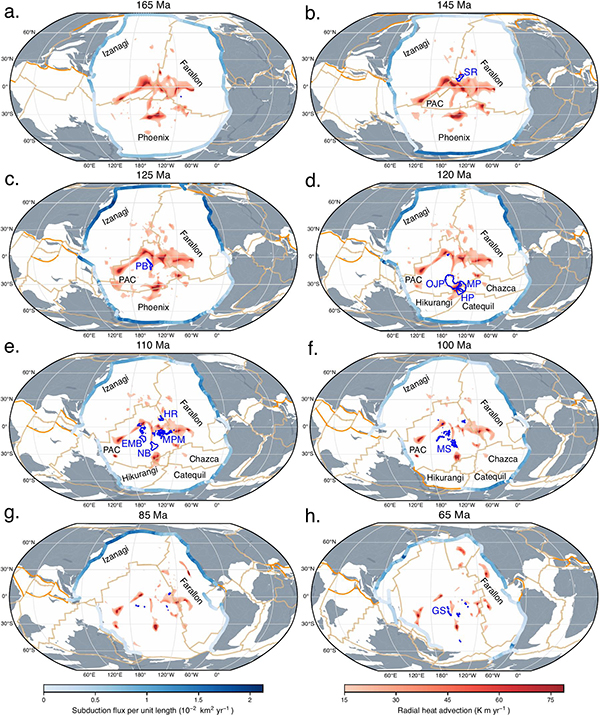
The study reveals that accelerated subduction and plume-ridge interaction are not mutually exclusive alternative mechanisms, but rather different manifestations of the same continuously evolving plate-mantle coupled system at different stages. Subduction modulated the intensity of deep-mantle hot upwellings from above, while the intersection between migrating ridges and mantle plumes provided the key triggering condition for large-scale melting and eruption. The simultaneous peaks in subduction flux and mantle upwelling around 130–125 Ma marked a particularly vigorous phase of whole-mantle convection. This provides a new perspective for understanding the links between Cretaceous deep-Earth processes and major environmental events at Earth’s surface.