Recently, faculty and students from Ocean University of China (OUC) who participated in China’s 42nd Antarctic Expedition successfully completed their missions and returned to Qingdao. The expedition was supported by the research icebreakers Xue Long and Xue Long 2, which departed together from Shanghai on November 1, 2025. Xue Long returned on April 9, 2026. After completing routine summer cruise operations, Xue Long 2 returned to Prydz Bay, Antarctica, for an autumn survey cruise and arrived back in China on May 18, 2026, after a 199-day voyage covering approximately 35,000 nautical miles.
The colleges and research institutions at OUC dispatched several research teams to participate in the summer and autumn comprehensive survey cruises. They successfully completed key tasks, including physical oceanography surveys, mesopelagic fish surveys, and microbial ecology observations, contributing OUC expertise to China’s polar research.
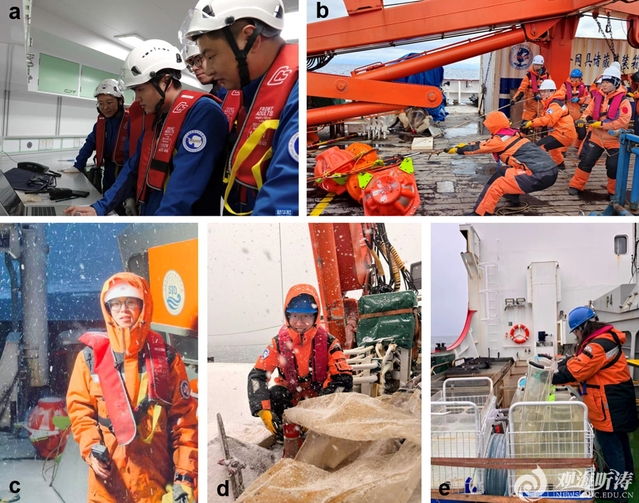
Professor Song Dehai from the Key Laboratory of Physical Oceanography of the Ministry of Education and Nie Lingyun, a doctoral student from the Deep Sea and Polar Fisheries Research Center, participated in the expedition aboard the research icebreaker Xue Long. Wang Yehui, a postdoctoral researcher from the Deep Sea and Polar Fisheries Research Center, Su Yue, a doctoral student from the College of Marine Life Sciences, and Ren Jianping, a master’s student from the College of Oceanic and Atmospheric Sciences, participated in the expedition aboard the research icebreaker Xue Long 2. They traveled to multiple Antarctic sea areas and the Antarctic Peninsula to conduct summer scientific investigations in the Southern Ocean.
The physical oceanography team carried out systematic surveys of the marine environment using CTD/LADCP integrated observations, long-term mooring observations, underway deployment of XBT/XCTD probes, and other methods. The team recovered 4 moorings and deployed 7 moorings in the Amundsen Sea and the Ross Sea, and recovered 3 moorings and deployed 1 mooring in the Cosmonauts Sea. Across these sea areas, the team obtained hydrographic profile data from 63 stations, upper-ocean temperature, salinity, and current data along the cruise tracks, as well as long-term continuous observation data from multiple moorings.
The team from the Deep Sea and Polar Fisheries Research Center conducted systematic surveys of marine fish ecosystems in multiple Antarctic sea areas using various sampling methods, including midwater trawls, Bongo nets, bottom longline sampling, eDNA sampling, and underway acoustic surveys. The team collected a large number of samples of key Southern Ocean fish species at different life-history stages.
The team from the College of Marine Life Sciences conducted diverse and comprehensive surveys of microbial diversity in the Southern Ocean using a combination of methods, including CTD water sampling, a medium-scale tangential flow filtration and concentration system, and aerosol sampling.
The samples and data collected by these teams provided key support for understanding the waters around Antarctica, air-sea-ice interactions in the Southern Ocean, and their multifaceted impacts on ecosystems, including physical oceanographic processes, fish communities, and microbial communities.
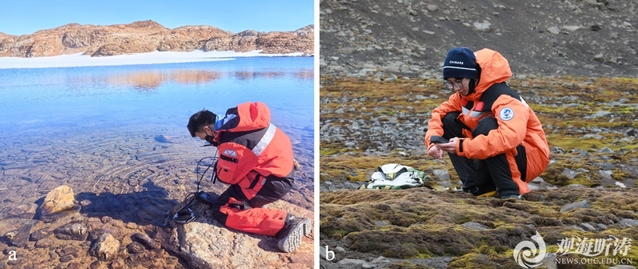
Associate Professor Li Kang from the College of Marine Life Sciences participated in biological and ecological monitoring during the summer season at the Antarctic Zhongshan Station. The monitoring covered the environmental characteristics and microbial distribution patterns of the sea areas, lakes, soils, and other environments around the Station. Chu Jiajun, a master’s student from the same college, participated in the station-based surveys at the Antarctic Great Wall Station. He completed continuous sampling in tundra, intertidal zones, and lakes, collected samples including intertidal sediments and tundra soils, and conducted in situ microbial cultivation. These station-based activities provided basic data and scientific evidence to assess the impacts of global climate change on Antarctic ecosystems and to support ecological and environmental management at Antarctic research stations.
Following completion of the summer cruise, Professor Sun Peng from the Deep Sea and Polar Fisheries Research Center, together with Engineer Sun Yongming, postdoctoral researcher Zhang Yueqi, and Doctor Yong Jianlin from the College of Oceanic and Atmospheric Sciences, boarded the research icebreaker Xue Long 2 from March to April 2026 and returned to Prydz Bay, for an autumn survey cruise under more severe environmental conditions. This marked the second consecutive year in which OUC participated in China’s autumn Antarctic expeditions.
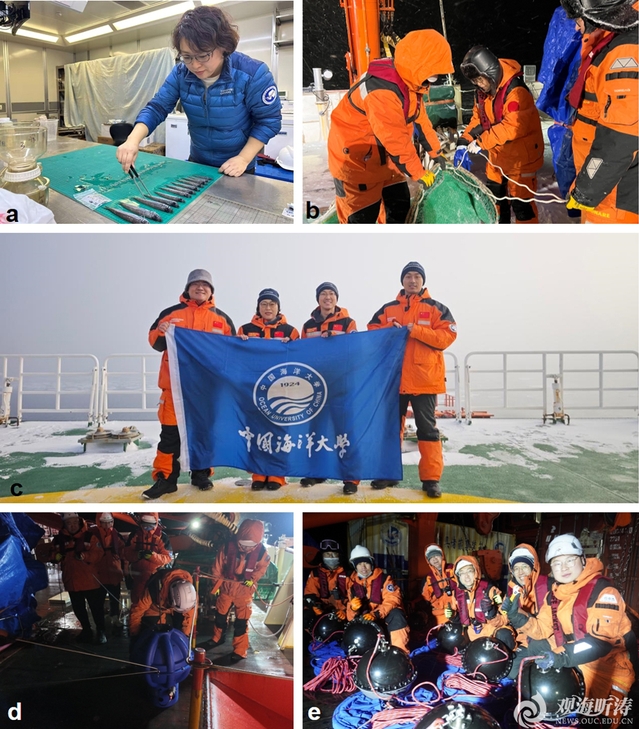
Using an improved midwater trawl, Professor Sun Peng overcame the challenges of fish trawling under complex ice conditions and collected a large number of samples of dominant fish species at different life-history stages in Prydz Bay in autumn. This filled a long-standing gap in China’s autumn fish sampling in this region, laying an important foundation for research on the overwintering strategies and ecological effects of key species in Prydz Bay.
Sun Yongming served as head of the midship deck team and was responsible for physical oceanography fieldwork during the cruise. Together with Zhang Yueqi and Yong Jianlin, he participated throughout the CTD/LADCP integrated observations at 40 stations in Prydz Bay, the deployment of 1 mooring, and underway marine lidar observations.
With strong support from the expedition team, OUC researchers also successfully completed China’s first networked observation mission targeting mesoscale eddies in the Southern Ocean. A total of 27 deployments of observational instruments were carried out, including China’s independently developed “Shenhai Xuanwu” profiling floats and drifting air-sea interface buoys. This is the first time that the “Shenhai Xuanwu” floats were deployed in the Southern Ocean. The completion of this work marked the expansion of the China Deep Argo Ocean observation network led by OUC into the Southern Ocean.
The data obtained during this cruise provided key in situ observational support for understanding autumn and winter polynya processes in Prydz Bay; investigating the physical processes and mechanisms that regulate the formation and export of high-density shelf water in autumn; and studying the three-dimensional structure, formation and evolution mechanisms of mesoscale eddies in the Southern Ocean and their material-energy transport effects.
As an important contributor to China’s polar research, OUC will continue to promote interdisciplinary integration in polar sciences and strengthen its capacity for polar expeditions, providing solid support for China’s efforts to deepen research on the mechanisms driving rapid Antarctic change, respond effectively to global climate change, and actively participate in Antarctic governance.