Recently, Professors Li Sanzhong and Suo Yanhui from the Key Laboratory of Submarine Geosciences and Prospecting Techniques of the Ministry of Education at Ocean University of China (OUC), in collaboration with several research teams from China and abroad, published a research article online in Nature Communications entitled “Convergent mantle flow and plate kinematics contribute to South China Sea rifting.” The study reveals a new mechanism by which deep mantle flow and plate kinematics jointly controlled the development of South China Sea rifting, providing new constraints on the deep geodynamic processes underlying the formation and evolution of the South China Sea.
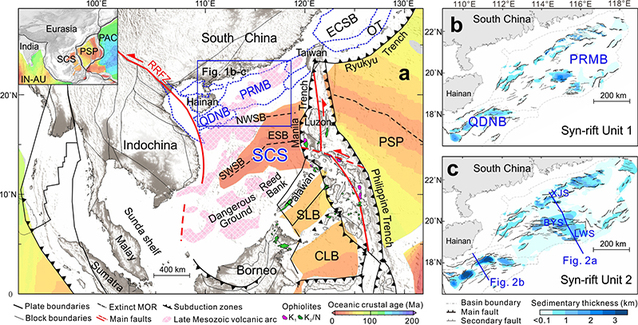
The South China Sea (SCS) is the largest marginal sea in the western Pacific. Its formation and evolution have long been an important frontier topic in international geoscience research. Several competing models have been proposed to explain the mechanisms of the opening and formation of SCS, including tectonic extrusion of the Indochina Peninsula, south-directed subduction of the proto-SCS, rifting induced by the Hainan mantle plume, and plate-edge rifting related to Pacific subduction. However, the relative contributions of these geodynamic mechanisms and their interactions remain highly debated. To address this question, the research team integrated a large number of seismic images from the Pearl River Mouth Basin (PRMB) and the Qiongdongnan Basin (QDNB) and systematically reconstructed the rifting of the northern SCS margin. The results show that the northern SCS margin underwent a major transition from early Paleogene distributed extension to late Paleogene hyper-extension, with a clear pattern of progressive westward migration.
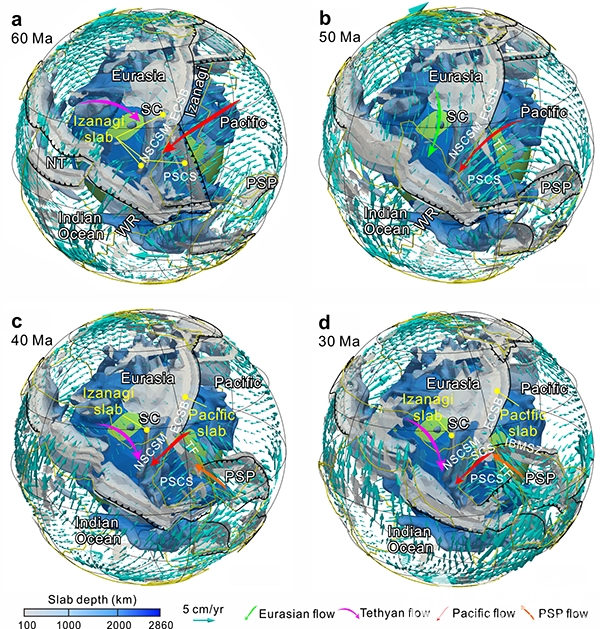
On this basis, the research team used the CitcomS mantle convection model constrained by global plate reconstructions to reconstruct the evolution of the deep mantle flow field beneath East Asia. The results show that since the Late Cretaceous, a long-lived low-pressure corridor has existed in the upper mantle beneath Southeast Asia, inducing the persistent convergence of mantle flow from the Pacific and mantle flow from the Tethyan-Eurasian domain beneath the region. This convergent mantle flow system shows good correspondence with the location of formation, extension direction, and spatiotemporal migration of the northern SCS rifting. The deep stress field generated by mantle flow, together with plate kinematics, shaped the regional stress framework for SCS rifting, and pre-existing structural weaknesses controlled the specific locations and styles of deformation. Therefore, the SCS rifting was not the result of a single geodynamic mechanism, but rather the product of the combined effects of deep mantle dynamics, plate kinematics, and lithospheric inheritance. This understanding expands the traditional explanatory framework of active and passive rifting models and offers a new geodynamic perspective for understanding the formation of marginal seas worldwide.