Recently, the Key Laboratory of Physical Oceanography of the Ministry of Education at Ocean University of China (OUC) published its latest research findings online in Nature Communications in an article entitled “Spring–Summer Caribbean Sea Marine Heatwaves Tied to Previous Winter Indian Ocean Marine Heatwaves.” For the first time, this study reveals an inter-ocean-basin and cross-seasonal teleconnection between marine heatwaves in the Indian Ocean and the Caribbean Sea. It clarifies the inter-basin linkage pathway and dynamic mechanism involved, and provides a precursor signal for predicting Caribbean Sea marine heatwaves several months in advance.
Marine heatwaves (MHWs) are extreme events of anomalous seawater warming and pose serious threats to marine ecosystems and coastal economies. Previous studies have mostly focused on the causes and evolution of MHWs within a single ocean basin, while it remains unclear whether MHWs in different ocean basins can influence one another.
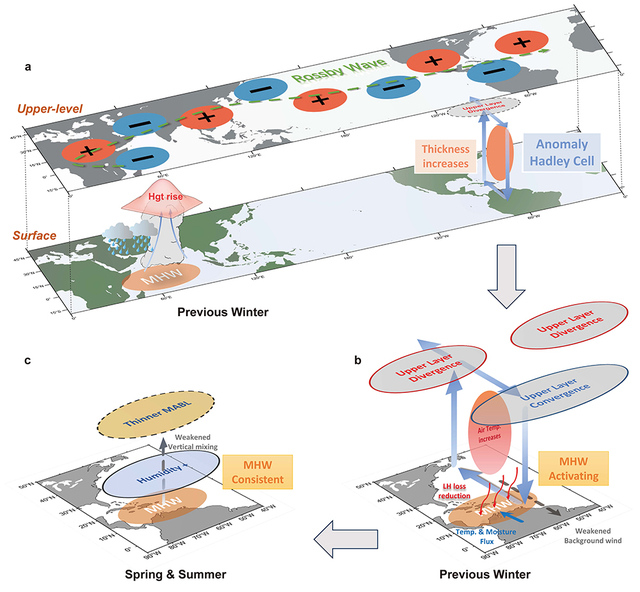
Using observational data and climate model simulations, this study reveals for the first time a significant inter-ocean-basin teleconnection between MHWs in the Indian Ocean and those in the Caribbean Sea. Specifically, boreal spring and summer MHWs in the Caribbean Sea are significantly connected to MHWs in the Indian Ocean during the preceding winter. The study further identifies the teleconnection mechanism through which Indian Ocean MHWs affect Caribbean Sea MHWs: (1) triggering convection: boreal winter MHWs in the Indian Ocean trigger strong atmospheric convection; (2) exciting waves and enabling cross-ocean-basin propagation: this convection generates an eastward-propagating Indo-Pacific-Atlantic Rossby wave train (IPAT); (3) altering circulation: after reaching the Caribbean Sea, the IPAT wave train induces an anomalous regional anti-Hadley circulation and warming of the atmospheric column; and (4) generating MHWs: these circulation anomalies reduce the air-sea temperature difference over the Caribbean Sea and weaken sea-surface winds, thereby suppressing ocean evaporation and latent heat loss. This ultimately warms the winter sea surface in the Caribbean Sea, triggers and intensifies Caribbean Sea MHWs, and, with the heat-retaining effect of the marine atmospheric boundary layer, creates favorable conditions for active MHWs in the following spring and summer. This mechanism is partially reproduced in climate model simulations.
This study moves beyond the conventional approach of studying MHWs in isolation, revealing that extreme events can be remotely connected across ocean basins through an atmospheric bridge. It offers a new perspective for the seasonal prediction of MHWs and is of great significance for strengthening the prevention and mitigation of MHW-related disasters. In addition, the Caribbean Sea is home to highly fragile and important coral reef ecosystems; improving the prediction of MHWs in this region can help local authorities take early response measures and reduce ecological and fishery losses.