Recently, a research team led by Professor Ai Qinghui and Academician Mai Kangsen from the College of Fisheries at Ocean University of China (OUC), made important progress in research on phospholipid metabolism-mediated regulation of antiviral innate immunity. The findings were published in the Proceedings of the National Academy of Sciences (PNAS) under the title “Phosphoethanolamine cytidylyltransferase 2 integrates DAG metabolism and TBK1 activation to regulate antiviral innate immunity.”
As the central kinase in antiviral innate immunity, the activation of TANK-binding kinase 1 (TBK1) is tightly controlled. However, how host lipid metabolic pathways directly regulate TBK1 activity has long remained a key question in the field of immunometabolism. In this study, the researchers found that viral infection downregulates the expression of PCYT2, a key rate-limiting enzyme in phosphatidylethanolamine (PE) synthesis, leading to abnormal accumulation of its substrate, diacylglycerol (DAG). The accumulated DAG then activates protein kinase C-δ (PKCδ), which directly binds to and phosphorylates TBK1 at Ser716. This phosphorylation site acts as a “molecular switch” that promotes the canonical phosphorylation of TBK1 at Ser172, resulting in the hyperactivation of the TBK1–IRF3 signaling axis and ultimately initiating an efficient type I interferon-mediated antiviral immune response.
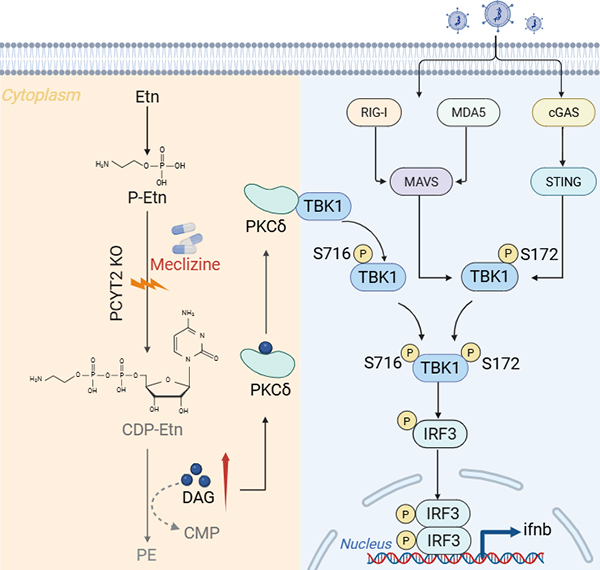
This regulatory axis is highly conserved across fish and mammals. For the first time, the study elucidates a cross-species shared mechanism by which PE synthesis regulates antiviral innate immunity, providing new molecular targets and intervention strategies for the prevention and control of viral diseases in fish. The findings directly link nutritional metabolism (the PE biosynthesis pathway) to antiviral immune signaling pathways, revealing a new function of structural phospholipid biosynthesis in regulating immune responses. This not only deepens theoretical understanding in nutritional immunology and immunometabolism but also offers a new metabolism-based green approach to preventing and controlling frequent viral diseases in aquaculture, with important theoretical significance and practical value.