Recently, Professor Zhang Shaoqing’s team at the Key Laboratory of Physical Oceanography of the Ministry of Education at Ocean University of China (OUC), in collaboration with Professor Tian Yongjun’s team at the Frontiers Research Center for Deep Sea and Polar Fisheries, has made significant progress in research on the seasonal migration patterns of skipjack tuna (Katsuwonus pelamis; hereafter SKJ) in the Northwest Pacific and the mechanisms underlying its response to climate variability. Drawing on a multi-decadal data set, the study quantitatively characterized, for the first time, a coherent annual migration pattern of SKJ, marked by northward expansion in spring and southward retreat in autumn, and innovatively revealed two-tiered regulatory regimes controlling habitat variability. The findings have been published online in Journal of Geophysical Research: Oceans under the title “The Responses of Skipjack Tuna in the Northwest Pacific to Climate Variability: Migration Pattern’s Seasonality and Heterogeneity.”
SKJ is the highest-yielding tuna species globally. For 11 consecutive years, its landings have ranked third globally in marine capture. A growing body of research has shown that climate modes exert important influences on the spatiotemporal variability of global tuna resources. The Northwest Pacific is the most important temperate fishing ground for SKJ, contributing approximately one quarter of its global catch. However, since the beginning of the 21st century, the SKJ fishery in this region has exhibited pronounced spatiotemporal anomalies, including extended fishing distances and compressed time periods. The mechanism by which climate variability governs the species’ seasonal life-history response has remained elusive.
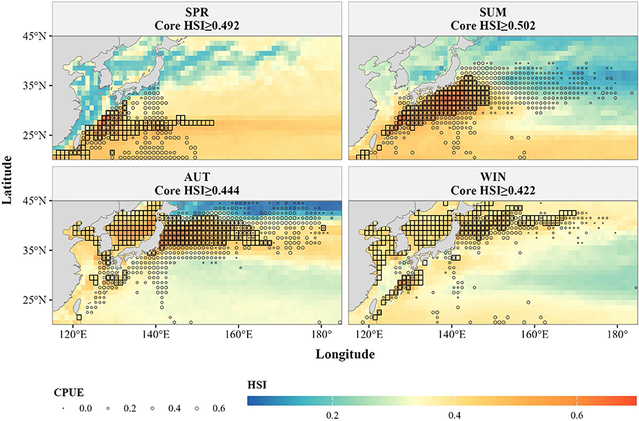
To address this question, the research team adopted a seasonal perspective and developed an integrated analytical framework that combines species distribution models with subsequent mechanism-diagnostic analyses. By leveraging a multi-decadal data set of SKJ pole-and-line fishery records and marine environmental parameters, the study first confirmed a pronounced seasonal migration pattern of SKJ in the Northwest Pacific: in spring and summer, its habitat expands northward following the Kuroshio path; in autumn and winter, after reaching the Kuroshio-Oyashio Transition Zone, they retreat southward. The best-performing model characterized the spatiotemporal patterns of the Habitat Suitability Indices (HSI) for SKJ in detail, revealing that sea surface temperature is the dominant environmental factor driving its annual migration, while the depth of the 17°C isotherm (D17) and sea surface salinity serve as secondary regulators in spring-summer and autumn-winter, respectively.
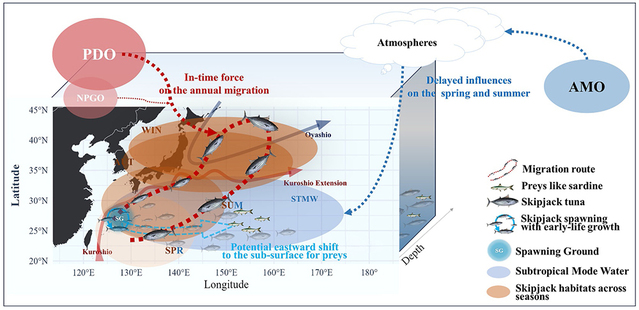
The study further diagnosed the nonlinear relationships between climate variability and SKJ habitat, and identified the Pacific Decadal Oscillation (PDO) as the dominant climate mode regulating SKJ habitat variability, and the Atlantic Multidecadal Oscillation (AMO) as the secondary modulator. The study also introduced the innovative concept of Habitat Dynamic Hotspots, defined as the spatial intersection between regions of high local explained variance and the contemporaneous core habitat. Using these hotspots as targeted areas, the team quantitatively analyzed their spatial-responsive relations with climate-environment factors. The results show that the spatial overlap between PDO-related sea surface temperature signals and habitat dynamic hotspots increased as the seasons progressed, peaking in autumn with a coverage of over 90%, when SKJ distribution extended to its northernmost range of approximately 45°N. In autumn and winter, northern cooling and enhanced salinity in the southwest jointly promoted the southward movement of SKJ. The underlying mechanism lies in the seasonal alternation of dominant environmental drivers: temperature governs the northward migration and spawning processes in spring and summer, while exerting year-round influence; salinity plays a key role in foraging and overwintering grounds in autumn and winter. In addition, concurrent and lagged associations were observed between SKJ habitat and the AMO in spring and summer (p< 0.05). In spring, the AMO modulates thermal conditions in and around spawning grounds, thereby influencing SKJ spawning and early-life history stages. In summer, the AMO-related Subtropical Mode Water region may affect forage availability and promote foraging movements of SKJ. Based on these findings, the study proposes a dual-pathway climate-driven framework for SKJ habitat in the Northwest Pacific: a PDO-dominated fast physical pathway, which establishes the SKJ migration template through in-time forcing on the Kuroshio system; and an AMO-dominated slow integrated pathway, which produces lagged fine-scale adjustments by coupling atmospheric teleconnections and oceanic memory with SKJ life-history processes. Together, these two pathways shape the seasonal variability and spatial heterogeneity of SKJ habitat dynamics.
From an interdisciplinary perspective integrating physical oceanography and fisheries biology, this study moves beyond the conventional correlation-based paradigm of climate phases and fishery distributions, shifting the research focus from large-scale distributional changes driven by climate-phase differences to the fine-scale coupling of seasonal environmental conditions with SKJ life-history processes. The findings deepen scientific understanding of SKJ migration patterns, provide a scientific basis for dynamic prediction of SKJ resources and climate-adaptive fisheries management, and offer a paradigm reference for studying the responses of highly migratory marine organisms to global climate change.