On May 11, “Personalized Pricing in the Presence of Privacy Concerns,” a research article co-authored by Zhang Mengyu, a young faculty member from the School of Economics at Ocean University of China (OUC), and Professor Chen Zhiqi from Carleton University, Canada, was published online in Management Science, a top international journal in management.
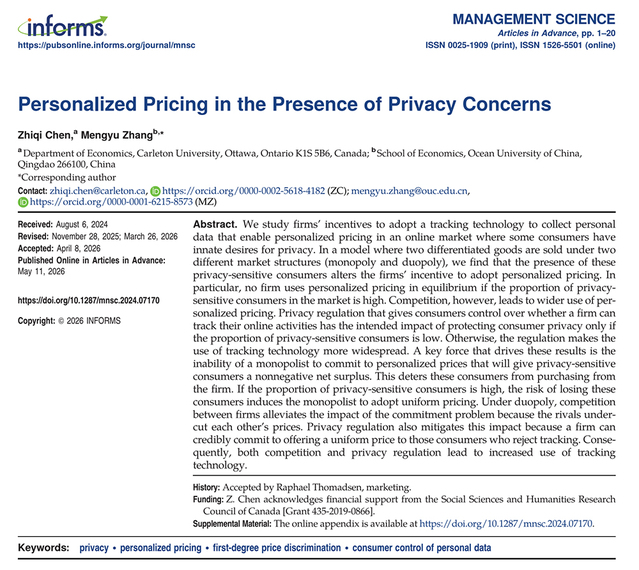
The article explores firms’ incentives to adopt a tracking technology to collect personal data that enables personalized pricing in an online market where some consumers have innate desires for privacy. By constructing and analyzing a model in which two differentiated goods are sold under two different market structures, namely, monopoly and duopoly, the researchers find that the presence of privacy-sensitive consumers alters firms’ incentives to adopt personalized pricing. In particular, no firm uses personalized pricing in equilibrium if the proportion of privacy-sensitive consumers in the market is high. Competition, however, leads to wider use of personalized pricing. Privacy regulations that give consumers control over whether a firm can track their online activities have the intended impact of protecting consumer privacy only if the proportion of privacy-sensitive consumers is low. In the meantime, such regulation makes the use of tracking technology more widespread, meaning that more firms will use the technology and the same firm will use it under a wider range of circumstances. A key force driving these results is the firms’ commitment problem. In the case of a monopoly, the monopolist cannot credibly commit to offering personalized prices that give privacy-sensitive consumers a nonnegative net surplus. This deters these consumers from purchasing from the firm. If the proportion of privacy-sensitive consumers is high, the risk of losing these consumers induces the monopolist to adopt uniform pricing. Under a duopoly, competition between firms alleviates the impact of the commitment problem because the rivals undercut each other’s prices. Privacy regulation also mitigates this impact because a firm can credibly commit to offering a uniform price to those consumers who reject tracking. Consequently, both competition and privacy regulation lead to increased use of tracking technology.