On March 26, a team led by Professor Dong Yunwei from the College of Fisheries and the MOE Key Laboratory of Mariculture at Ocean University of China (OUC) published a research article entitled “Hexokinase Expansion in Thermophilic Snails Supports Extreme Heat Tolerance” in the leading journal Science China Life Sciences.
Against the backdrop of global warming, understanding the adaptive mechanisms that enable organisms to tolerate extreme heat has become a crucial scientific question in modern biology. The Echinolittorina snails provide an ideal model for investigating this issue. These small molluscs, which live in the high intertidal zone and have an adult size of less than one centimeter, are among the most thermotolerant animal groups known to date. To survive the harsh high-temperature conditions of their habitats, they have evolved exceptionally strong heat tolerance, with lethal thresholds reaching as high as 55 °C. However, due to the lack of genomic data, the genomic mechanisms underlying their adaptation to extreme heat remained unexplored. To address this research gap, the team constructed the first chromosome-level genomic resources for Echinolittorina snails, covering two species: E. radiata, which is widely distributed along the coast of China, and E. malaccana, which is found along the coast south of the Yangtze River. Through functional investigations combining multi-omics and cellular assays, the study provided the first genomic-level evidence for the extreme heat tolerance of Echinolittorina snails.
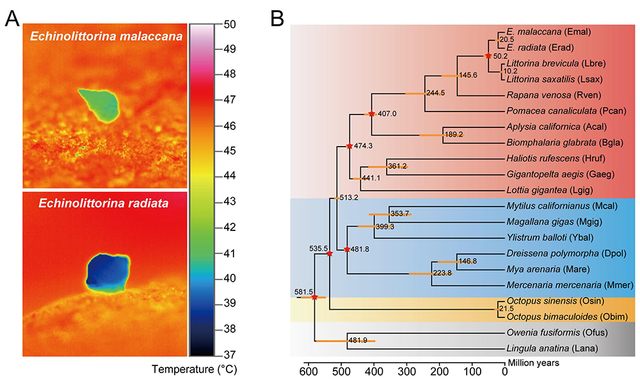
Phylogenomic analysis revealed that within the subfamily of Littorininae, the divergence between Echinolittorina and its sister genus Littorina occurred approximately 50 million years ago. This timing coincides with the Paleocene–Eocene Thermal Maximum, the warmest interval of the Cenozoic era, with global mean surface temperatures 5~8°C higher than those of the present day. The study suggests that this extreme warming event may have imposed strong natural selection pressures, driving the evolution of extreme heat adaptation in Echinolittorina snails.
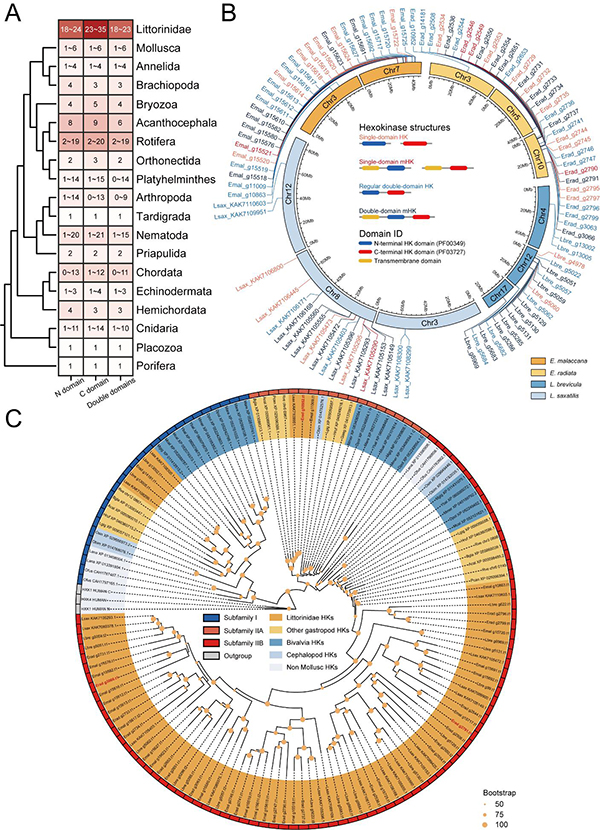
Gene family analysis revealed significant lineage-specific expansion of the hexokinase (HK) gene family in Littorininae snails. The researchers identified and counted HK genes across 1,872 published animal genomes from 18 phyla, and found that Echinolittorina snails possessed up to 36 HK genes, the highest number observed among all surveyed animals. Further clustering analysis of molluscan HK sequences resolved three distinct HK subfamilies, designated I, IIA, and IIB. It is worth noting that all HK genes expanded in Littorininae snails belonged exclusively to the IIB subfamily. Through genomic localization and structural analysis of HK genes, the study found that the expansion of the IIB subfamily in Littorininae snails was primarily driven by tandem duplication, accompanied during evolution by domain fusion in 26.7-44.0% of Littorininae HKs and domain deletion in 21.7-36.1% of them, ultimately giving rise to novel HKs with diversified structures.
The most important finding of this study is the first report in animals of a novel class of membrane-anchored HKs, or mHKs, that acquired transmembrane structures through domain fusion. These mHKs are members of the Littorininae IIB subfamily that underwent gene duplication and domain fusion. Anchored to the cell membrane through N-terminally fused immunoglobulin (Ig)‑like domains, these special HKs have acquired subcellular localization features distinct from those of canonical HKs, which are distributed in the intracellular space. Functional assays based on transient transfection demonstrated that mHKs could improve cell viability under thermal stress, and that this protective effect was further enhanced by mannose preconditioning. Metabolomic analysis further revealed that cells expressing mHKs had higher levels of ATP and more glycolytic intermediates than the control group. These results suggest that mHKs may help cells meet the increased energy demands under high-temperature stress by optimizing cellular energy metabolism.
This study links the high-temperature adaptation of Echinolittorina snails with lineage-specific expansion of the HK gene family and functional innovation arising from its structural diversification, providing new genomic resources and theoretical insights for understanding the mechanisms underlying organisms’ adaptation to extreme heat.