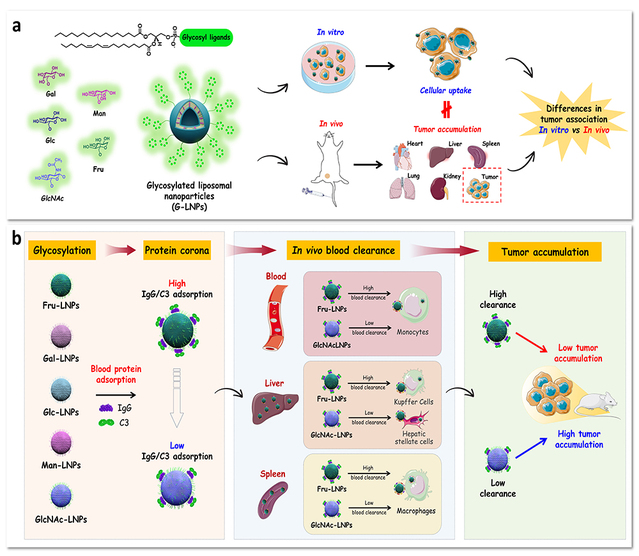
Recently, the research team led by Professor Mao Xiangzhao from the College of Food Science and Engineering at Ocean University of China (OUC), the research team led by Professor Jiang Shuai from the School of Medicine and Pharmacyat OUC, and Professor Katharina Landfesterfrom the Max Planck Institute For Polymer Researchin Germany jointly constructed a series of novel glycosylated phospholipidsthrough enzymatic synthesis. They also systematically elucidated their functional properties and structure-function relationships in liposomaldrug delivery. The research findings were published in Angewandte Chemie International Editionin an article entitled “Incorporation of Novel Synthetic Glycolipids in Liposomal Nanoparticles Affects Opsonization and In Vivo Clearance”.
Saccharides are among the important biological recognition signals in living systems. The glycocalyx, a dense layer of glycoproteins and glycolipids on cell membranes, plays key roles in cell recognition, adhesion, immune regulation, and signal transmission. Inspired by natural glycocalyx structure and functions, surface glycosylation of nanomedicines has emerged as a promising strategy to enhance drug delivery by exploiting carbohydrate–receptor interactions.However, the precise, efficient, and scalable preparation of novel glycosylated phospholipid materials still faces many challenges, including structural controllabilityand synthetic efficiency. In addition, there is still a lack of systematic understanding of how surface saccharide structures regulate the interactions between nanomedicines and biological molecules and interfaces, such as plasma proteins and immune cells, and how these interactions further affect their biodistribution and in vivo clearance.
To address these challenges, the research team developed an enzyme-catalyzed synthesis strategy. Through the rational design of phospholipase D(PLD), the team catalytically synthesized a series of phosphatidyl saccharide molecules with well-defined structures, and further assembled them into glycosylated liposomal nanoparticles (G-LNPs)to improve in vivo drug delivery efficiency. By utilizing the PLD-catalyzed transphosphatidylation reactionto selectively couple glycosidedonors with natural phospholipids, the research team successfully synthesized novel non-natural phosphatidyl saccharide compounds with defined structures. The study found that different saccharide structures can significantly affect the in vivo behavior of liposomes. Among the saccharides examined, N-acetylglucosamine (GlcNAc)-modified liposomal nanoparticles demonstrated a superior tumor accumulation and reduced systemic clearance compared toother glycosyl ligands, including glucose, galactose, fructose, and mannose. Further proteomicstudies revealed that GlcNAc modification significantly reduced the adsorption of both immunoglobulin G (IgG)and complement C3 (C3) on the surface of liposomes, thereby modulating protein corona composition, resulting in prolonged blood circulation, ultimately enhancing tumor accumulation and therapeuticefficacy.
This studysystematicallyreveals a clear correlation among glycosyl ligands, protein corona composition, and the in vivo fate of LNPs.It demonstrates that rational enzymatic design of surface glycosyl structures can precisely regulate the interactions between nanomedicines and plasma proteins, thereby enabling control over the in vivo behavior of nanomedicines. The findings not only provide a new theoretical basis for the precision biomanufacturing of glycosylated liposomal nanoparticles but also lay an important foundation for understanding the in vivo fate offunctional liposomal nanomedicines and facilitating their translational application.