Recently, the team led by Professor Liu Weizhi from the MOE Key Laboratory of Marine Genetics and Breeding of the College of Marine Life Sciences and the Fang Zongxi Center for Marine Evo-Devo at Ocean University of China (OUC) has made a breakthrough in the application of marine biological enzymes. After more than a decade of dedicated research in collaboration with partner universities and enterprises, the team has overcome multiple technical bottlenecks, and its new marine oligosaccharide drug for acute kidney injury (AKI) has received approval from the National Medical Products Administration (NMPA) to enter clinical trials (Approval No. 2026LP00688). This is the world’s first marine oligosaccharide drug for AKI to enter the clinical trial stage. AKI is a common and critical clinical syndrome with a high incidence, and there is still no effective targeted drug therapy available. The clinical investigation of this innovative drug marks an important step forward in filling this therapeutic gap.
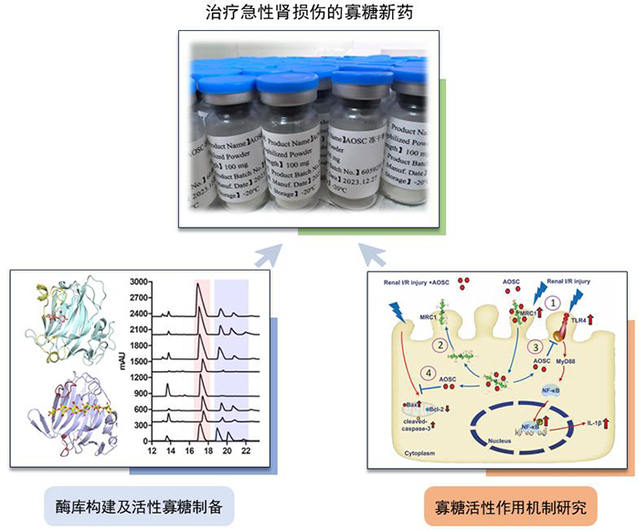
This achievement is one of the representative outcomes of the team’s long-term efforts in integrated industry-university-research-application cooperation. Professor Liu Weizhi’s team has been committed to addressing the technical bottleneck in the large-scale preparation of homogeneous marine oligosaccharides by using novel marine biological enzymes. The team has established a comprehensive research system covering new enzyme discovery, enzyme library construction, structural and functional analysis of enzymes, enzyme engineering, and enzymatic oligosaccharide production, thereby continuously advancing the application of marine glycoside hydrolases in the development of bioactive oligosaccharides. To date, the team has developed multiple large-scale enzymatic preparation technologies for bioactive marine oligosaccharides with drug development potentials.
In the meantime, to address the challenge of unclear pharmacodynamic targets in the development of marine oligosaccharide drugs, the team collaborated with the groups led by Professors Wang Weidong and Li Chunling from Sun Yat-Sen University to investigate the bioactivities and mechanisms of these oligosaccharides at multiple levels. Their studies confirmed that the marine oligosaccharide can inhibit inflammatory responses and alleviate renal tubular epithelial cell injury, thereby effectively improving AKI induced by ischemia-reperfusion, sepsis, and drug toxicity, protecting renal function, and delaying progression to chronic kidney disease. This work has laid a solid pharmacodynamic foundation for the development of the innovative drug. Related results have been published in leading journals in the field, including International Journal of Biological Macromolecules (2025), Acta Pharmacologica Sinica (2025), Life Sciences (2025), Communications Biology (2022), Journal of Agricultural and Food Chemistry (2021), and Biochemical Journal (2014). The team has also been granted multiple national invention patents, including ZL201710008519.8 and ZL201710430426.4.
Building on this foundation, the team carried out in-depth collaboration with Haitang (Nantong) Biotechnology Company Ltd., achieving a key technological breakthrough in the large-scale production of homogenous marine oligosaccharides. The partner company led and completed the new drug’s preclinical studies, including pharmaceutical, pharmacodynamics, safety, and pharmacokinetic evaluations. Upon review and approval by the NMPA, the drug was cleared to proceed to clinical trials.