To advance the high-quality development of AI-empowered research in higher education in line with China’s strategic plans for artificial intelligence and the requirements set forth in relevant policy documents, the Interdisciplinary Research Group on Second Language Acquisition led by Professor Yang Lianrui from the College of Foreign Languages at Ocean University of China (OUC) has made important progress in research at the intersection of artificial intelligence and second language acquisition.
Grounded in China’s digital transformation in education, the team has published a series of four studies in the internationally leading journal Innovation in Language Learning and Teaching, as well as in leading Chinese journals in linguistics, including Modern Foreign Languages, Foreign Languages in China, and Foreign Language Education. These achievements mark the emergence of OUC’s distinctive strength in the interdisciplinary field of “AI Plus Second Language Acquisition” and provide solid theoretical support and empirical evidence for smart foreign language education in the age of artificial intelligence.
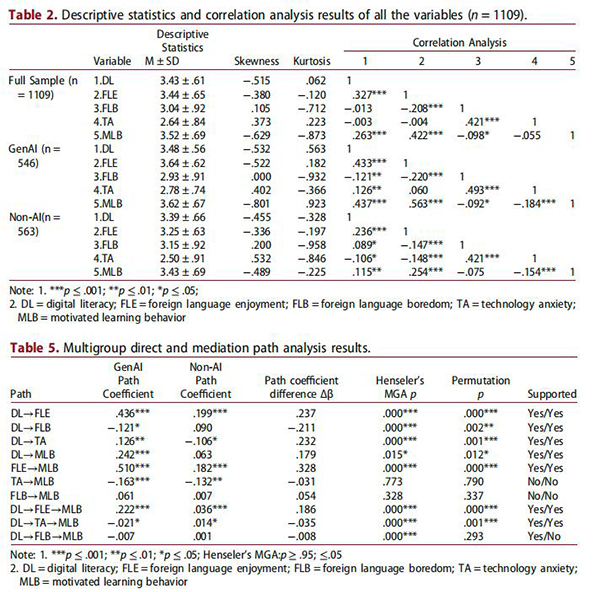
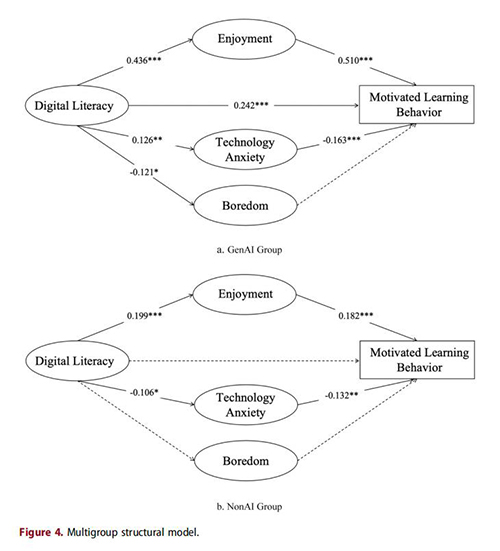
Among these research outcomes, Professor Yang’s team has focused on the reshaping of psychological mechanisms in generative artificial intelligence (GenAI) environments and achieved an important empirical breakthrough. Relevant findings were published in a research article entitled “Differential impact of GenAI use on EFL learners’ digital literacy, emotions, and motivated learning behavior in Informal Digital Learning of English: a multigroup path analysis” in Innovation in Language Learning and Teaching.
Informal Digital Learning of English (IDLE) is increasingly becoming an important pathway for second language acquisition. While GenAI has greatly enhanced the interactivity of IDLE, it has also brought unprecedented challenges to learners’ psychological mechanisms and digital literacy. Against this backdrop, investigating the complex interaction mechanisms among learners’ cognition, emotions, and motivated learning behaviors in GenAI-supported environments has become a major topic in current international second language acquisition research. However, comparative studies on learners’ cognitive and affective mechanisms across different intelligent technology environments remain limited. Incorporating Social Cognitive Theory (SCT) and Control-Value Theory (CVT), this study proposes a dual cognitive-affective theoretical model and a corresponding hypothesized model for informal digital English learning, and conducts a large-scale comparative analysis of learners’ multidimensional psychological variables. The subject of this study is a total of 1,109 Chinese university EFL learners, strictly categorized into a GenAI group and a Non-AI group. Using Partial Least Squares Structural Equation Modeling (PLS-SEM) and multigroup path analysis, the researchers conducted path analysis and statistical analysis to examine the relationships among digital literacy, achievement emotions, and motivational learning behavior. The study yielded two major findings. First, at the level of the overall psychological mechanism, positive chain mediation of “digital literacy→ foreign language enjoyment→ motivated learning behavior” was significantly validated, with foreign language enjoyment serving as the predominant mediator bridging digital literacy and voluntary engagement. Second, at the level of differentiated effects across technological environments, multigroup path analysis revealed significant heterogeneity between the two groups. The findings showed that the GenAI environment exerted a distinctive strengthening effect on this mechanism; compared with the Non-AI group, higher digital literacy in the GenAI group not only promoted foreign language enjoyment more strongly, but also led to a reversal in the trajectory of technology anxiety. More specifically, in traditional digital learning contexts, greater digital literacy was generally associated with lower technology anxiety; in GenAI environments, however, higher digital literacy positively predicted a moderate technology anxiety. This distinctive affective reversal reveals the adaptive drive that higher literate learners develop when confronting AI complexity. It provides a strong empirical support for understanding how large language models may positively shape learners’ emotions and challenges the conventional one-sided view of digital anxiety as purely negative.
Building on its in-depth insights into the underlying affective mechanisms of learners, the team further extended its research to the strategic dimension of AI-empowered learning. Echoing its previous work on emotions, the team published the article “Latent profiles of self-regulated learning strategies in informal English reading learning supported by GenAI and their effects on engagement” in the sixth issue of Foreign Language Education in 2025. Focusing on the specific context of GenAI-supported informal English reading, the study employed latent profile analysis to identify four heterogeneous profiles of learners’ self-regulated learning strategies, forming a nonlinear continuum ranging from the low-strategy use type to the integrated high-strategy type. The findings confirmed that learners across different profile groups differed significantly in behavioral, emotional, and cognitive engagement, and that motivational regulation strategies significantly promoted emotional engagement across all groups. Closely aligned with the team’s earlier findings on emotional mechanisms such as foreign language enjoyment and technology anxiety, this study further reveals, from the perspective of learning strategies, how precise diagnosis and targeted intervention can empower learners to engage in deep learning in intelligent environments.
Meanwhile, these precise analyses at the micro level are mutually reinforcing with the team’s macro-level theoretical construction and comprehensive mapping of the field. The team successively published “Second Language Acquisition in the Context of Large Language Model of ChatGPT” along with related scoping and review studies in Modern Foreign Languages and Foreign Languages in China. These studies systematically explained how large language models can effectively empower second language acquisition through key pathways such as creating contexts, generating resources, fostering output, and providing instant feedback. They also prospectively examined the potential risks of intelligent applications, such as “information cocoon”, and their possible weakening of student initiative. At the same time, they comprehensively reviewed relevant empirical studies in China and abroad, confirming the significant role of artificial intelligence in enhancing learners’ psychological experiences and other dimensions of language learning.