Recently, the Sea-STAR Program team at Ocean University of China (OUC) published a research article entitled “Neutrino tomography with a three-dimensional model of Earth’s density”online in Chinese Physics C. The Sea-STAR Program for neutrino detection and research is an OUC initiative aimed at strengthening organized scientific research and promoting interdisciplinary integration. It is also an important measure to bring together research strengths for original and leading scientific and technological breakthroughs at the frontiers of global science. The program is jointly implemented by OUC, the Chinese Academy of Sciences(CAS) Institute of High Energy Physics, and the CAS Institute of Acoustics.
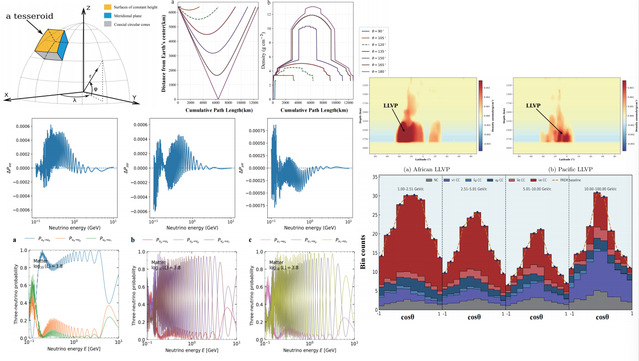
Neutrino Earth tomography is a new method for probing the Earth’s internal structure by utilizing the oscillation characteristics that occur when neutrinos are affected by the matter density distribution as they pass through the Earth. Compared with traditional seismological methods, it offers a new observational perspective for understanding the Earth’s deep three-dimensional structure. Existing studies mostly rely on one-dimensional, radially symmetric Earth models such as PREM and AK135. While these models have played an important role in early feasibility studies, they failed to reflect the lateral heterogeneity inside the Earth, particularly the impact of complex structures such as large low-shear-velocity provinces (LLSVP)in the deep mantle on neutrino propagation. Therefore, building a three-dimensional density model that better reflects the structuralcharacteristics of the real Earth, and carrying out calculations of neutrino propagation and oscillation on this basis, is an important direction for further advancing research on neutrino Earth tomography.
To address these issues, building on its previous work, the research team developed a three-dimensional Earth density calculation framework based on the tesseroid discretization. By integrating models including PREM, CRUST1.0, and HMSL-S06, the study established a non-spherically symmetric three-dimensional Earth density model that incorporates informationon large low-shear-velocity provincesin the deep mantle. At the same time, the team also developed a neutrino trajectory-tracking method suitable for three-dimensional density fields, and derived formulas for calculating the total mass and axial moment of inertia of the discrete model to examine its overall physical consistency. On this basis, the researchers further combined the exact three-flavor neutrino oscillation calculations with publicly available Super-Kamiokande (SK) dataproducts, and compared the oscillation probabilities event count distributions under the three-dimensional model and the conventional one-dimensional reference model. The results show that the framework can effectively characterize lateral density anomalies inside Earth and provide a methodological basis for evaluating the effects of three-dimensional Earth structure on atmosphericneutrino propagation and observational responses.