On April 12, a research team led by Professors Mao Yunxiang and Wang Dongmei from the College of Marine Life Sciences and the MOE Key Laboratory of Marine Genetics and Breeding at Ocean University of China (OUC) made new progress in the genetic transformation of red algae. The related work, entitled “Establishment of an efficient Agrobacterium-mediated transformation system for the economically important macroalga Pyropia yezoensis (Rhodophyta)”, was published in New Phytologist.
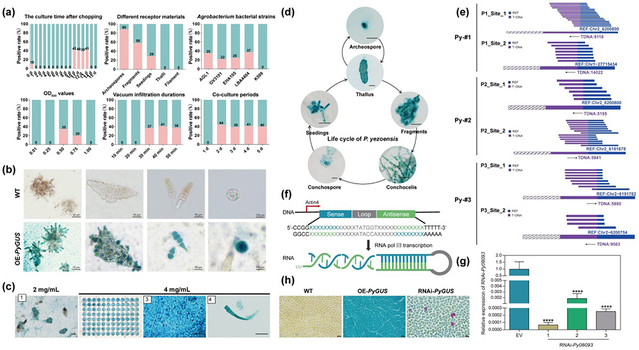
Pyropia yezoensisis an intertidal macroalga that possesses significant ecological benefits and economic value, and also serves as a model organism for studying the physiology and genetics of marine red algae. However, technical bottlenecks, including low transformation efficiency and difficulty in achieving stable expression, have long constrained research on gene function and precision molecular breeding of P. yezoensis. In this study, the researchers successfully established an Agrobacterium tumefaciens-mediated nuclear genetic transformation system for P. yezoensis. Based on the physiological and biochemical characteristics of P. yezoensis, the research team applied vacuum infiltrationto its genetic transformation for the first time, and systematically optimized key parameters, including the genetic elements of the vector, the starting condition of materials, strain selection, vacuum infiltration durations, and coculture periods, achieving an initial transformation efficiency between30%and40%. Following a stringent two-stage hygromycin selection, the teamalso recovereda stable transformation frequency of 0.02% and a post-selection positivity rate of 100%. Additionally, an effective RNAi system was established, enabling targeted silencing of endogenous genes.This marks the establishment of a bidirectional functional research capacity in the genetic toolbox for P. yezoensisof both gene overexpression and gene silencing.
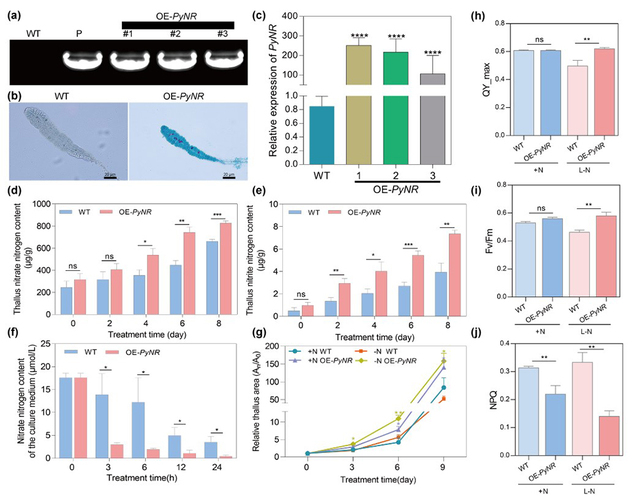
To verify the application value of this system, the research team focused on the key gene for nitrogen metabolism, the nitrate reductase gene PyNR, and successfully generated OE-PyNR transgenic lines that stably overexpress PyNR. This overexpression significantly enhanced nitrate uptake and assimilationin P. yezoensisthallus, improving their growth and photosyntheticadaptability under nitrogen-limited conditions. These findings identify PyNR as a key target gene for breeding new low-nitrogen-tolerant P. yezoensisvarieties, and fully demonstrate the practical value of this genetic transformation system in trait improvement and gene function analysis.