On January 31, a research team led by Professor Mao Xiangzhao from the College of Food Science and Engineering at Ocean University of China (OUC) published a research article entitled “An immune-inspired intelligent aptasensor with broad detection capability” in Trends in Biotechnology, a journal published by Cell Press. Drawing inspiration from living systems, the study pioneered an immune-inspired biomimetic strategy for aptamer engineering and developed an aptamer-nanozyme biosensor based on target-induced assembly of highly catalytic nanozymes. Integrated with a smartphone-based data readout platform, the biosensor can be broadly applied to the rapid and intelligent detection of multiple targets in marine foods. This work overcomes a key bottleneck restricting the practical application of enzyme-linked aptasensors in food analysis and detection, and advances the development of aptamer recognition and nanozyme catalytic transduction technologies, as well as their applications in food biosensing analysis and detection.
In recent years, biosensors have demonstrated indispensable value in food analysis and detection. Among them, aptasensors have attracted considerable attention and become a major research focus. Aptamers, obtained through the systematic evolution of ligands by exponential enrichment (SELEX) approach, offer advantages such as high specificity and programmability. By coupling aptamers with enzyme-catalyzed reactions, enzyme-linked aptasensors can be developed with broad application prospects. So far, relevant research is increasingly focused on the integration of aptamers with advanced materials aiming to enhance detection sensitivity, yet scant attention has been paid to resolving the inherent performance limitations. Meanwhile, complex food matrices and real-world detection environments may compromise the binding between aptamers and targets and the signal transduction of enzyme-catalyzed reactions, severely restricting the practical application of aptasensors. Under such challenging conditions, the design of high-affinity aptamer probes and the assembly of anti-interference catalytic materials are key to achieving reliable analysis and detection.
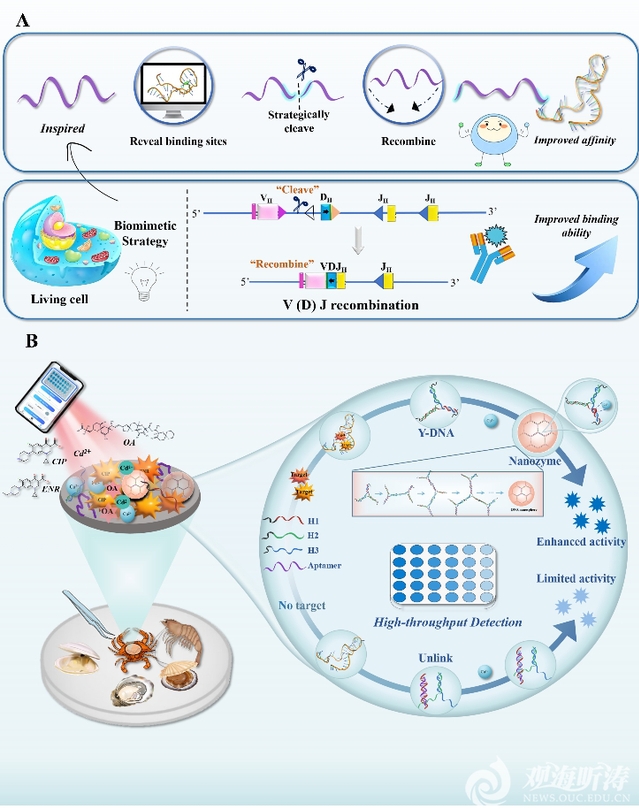
To address these challenges, Professor Mao Xiangzhao’s team drew inspiration from the evolutionary principles of living systems and pioneered an immune-inspired biomimetic strategy. Mimicking the V(D)J recombination mechanism, the team engineered aptamers through a single-strand topology-refactoring strategy, achieving up to a 133.3-fold enhancement in binding affinity. The study further exploited the aptamer-target binding mechanism to trigger and regulate the self-assembly of DNA nanosphere-Cu(II) composite nanozymes, effectively avoiding the problem that conventional enzyme-catalyzed signaling is easily interfered with by complex systems, and developed a sensor based on aptamer-specific recognition and nanozyme-catalyzed signal amplification. Integrated with smartphone-based colorimetric analysis, the sensor enables high-throughput screening of multiple trace contaminants in marine foods such as shrimp, crab, and shellfish, including antibiotics, toxins, and heavy metal ions. It demonstrates high accuracy and an ultra-low limit of detection at the pM level, showing broad detection capability. This study offers novel insights into the engineering design of aptamers and the establishment of synergistic mechanisms between aptamers and nanozymes, and also presents new avenues for the development of robust, nature-inspired biosensors for the real-world quality testing of marine foods and bioproducts.