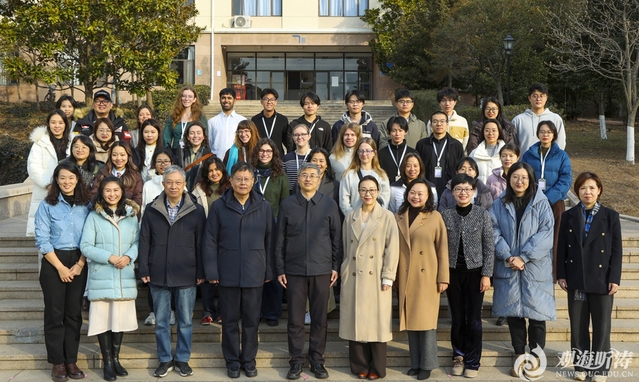
From January 12 to 25, Ocean University of China (OUC) hosted the 2026 International Youth Scholar Exchange Camp on Marine Environmental Sciences in Qingdao. The camp was jointly organized by OUC’s College of Environmental Science and Engineering, Chongben Honors College, and the School of International Education, and was supported by the International Summer School Program of the Chinese Government Scholarship under the China Scholarship Council. The event aimed to build a high-level international exchange platform and promote in-depth dialogue and cooperation among young scholars from China and abroad in the field of marine environmental sciences. The event attracted 26 outstanding participants from more than ten well-known universities and research institutions at home and abroad, including the University of Cambridge, University College London, the University of East Anglia, Newcastle University, the University of Queensland, Hokkaido University, Ehime University, IHE Delft Institute for Water Education, and OUC.
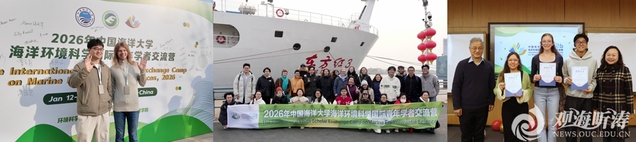
On the morning of January 14, the opening ceremony of the exchange camp was held at the Laoshan Campus. Professor Liu Yong, Vice President of OUC, attended the ceremony and delivered remarks. He noted that marine environmental sciences are an important frontier discipline for addressing global climate change and advancing sustainable development. He expressed the hope that, through this exchange camp, young scholars would exchange academic ideas, spark innovation, forge cooperative ties, and contribute youthful strength to global marine environmental governance. Prof. Jiang Wensheng, Dean of the College of Environmental Science and Engineering, introduced the significance and overall arrangements of the camp. As participant representatives, Jansen Hor from the University of Cambridge, and Liu Yihan from OUC shared their enthusiasm for research in marine environmental sciences and their expectations for the exchange program.
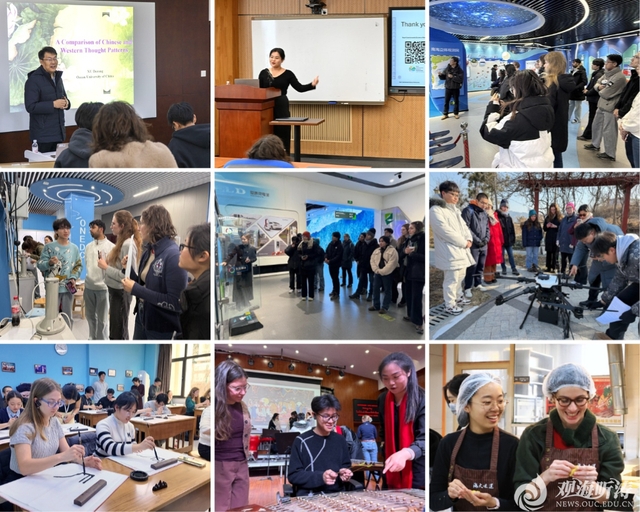
This exchange camp featured rich and diverse activities, with three core modules—academic exchange, field study, and cultural experience—systematically designed to integrate professional discussion, hands-on practice, and cross-cultural communication. In the academic module, 8 frontier lectures and 7 young scholars’ salons were organized, covering topics such as marine civilization, Chinese-Western culture comparison, marine numerical simulation, artificial intelligence, and climate change. In the field study module, participants boarded the research vessel Dong Fang Hong 3 and visited OUC’s Marine Science and Technology Exhibition Hall, the New Energy Eco-technology Museum of China, and the Xiaojianxi Municipal Solid Waste Integrated Treatment Park. They also took part in on-site teaching and industrial research activities, including fluid dynamics experiments, meteorological observations, and intertidal field surveys. In addition, participants immersed themselves in activities such as Chinese calligraphy, traditional folk music, and intangible cultural heritage handicrafts. Through these hands-on experiences, they appreciated the unique charm of traditional Chinese culture and gained a deeper understanding of China’s achievements in marine and ecological environmental development.