Recently, a research team led by Professor Hou Chunchao from the School of Materials Science and Engineering at Ocean University of China (OUC) made important progress in green electrocatalytic upcycling research. The related findings were published in the internationally renowned journals Journal of the American Chemical Society and Angewandte Chemie International Edition.
Driven by China’s “dual-carbon” goals and the urgent need for environmental pollution control, conventional thermochemical conversion routes powered by fossil energy can no longer balance resource utilization with environmental sustainability because of their high energy consumption and intense carbon emissions. In contrast, electrocatalytic technologies powered by renewable energy use water as green reaction medium and can generate highly reactive protonic hydrogen (*H) and hydroxide (*OH) in situ under mild conditions, opening up new possibilities for the upcycling of waste carbon resources and the efficient production of clean energy such as green hydrogen. However, the efficiency of aqueous electrocatalytic reactions is still constrained by several scientific bottlenecks, including interfacial water activation, migration and coupling of reactive intermediates, and the unclear competitive and cooperative mechanisms involved in multistep reactions. How to precisely regulate the production, transfer, and reaction behavior of *H/*OH through rational catalyst design, thereby improving product selectivity and overall energy efficiency, has become a central challenge in green electrocatalysis. Against this background, the researchers have focused on green electrocatalytic upcycling, integrating the interfacial design of environmentally friendly materials with mechanistic studies of water activation and reactive intermediate conversion pathways, with the aim of enabling the high-value conversion of industrial wastes and the efficient utilization of clean energy, and ultimately fostering a new paradigm featuring pollution reduction, carbon mitigation, and resource recycling.
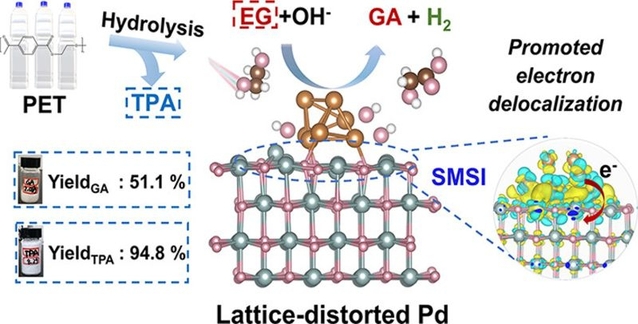
In the recycling and reuse of plastic wastes, the electrocatalytic upcycling of waste polyethylene terephthalate (PET) plastics still faces several bottlenecks, including low selectivity, catalyst poisoning, and difficulties in scaling up. To address these challenges, the team developed a lattice-distorted palladium (l-Pd) catalyst by controlling the interfacial metal–support interaction. Utilizing the lattice-distortion-driven electron delocalization, the catalyst enabled the efficient electrochemical conversion of ethylene glycol to glycolic acid. This study offers a new perspective for designing efficient catalysts for the electrocatalytic upcycling of PET wastes, providing both environmental and economic benefits. The related work, titled “Lattice-Distortion-Driven Electron Delocalization Enables Efficient Electrosynthesis of Glycolic Acid and Terephthalic Acid from Plastic Wastes”, was published in the Journal of the American Chemical Society. The first author of the paper is Wang Han, a 2023 master’s student in Materials Science and Engineering at the School of Materials Science and Engineering. OUC is the first corresponding institution of the paper.
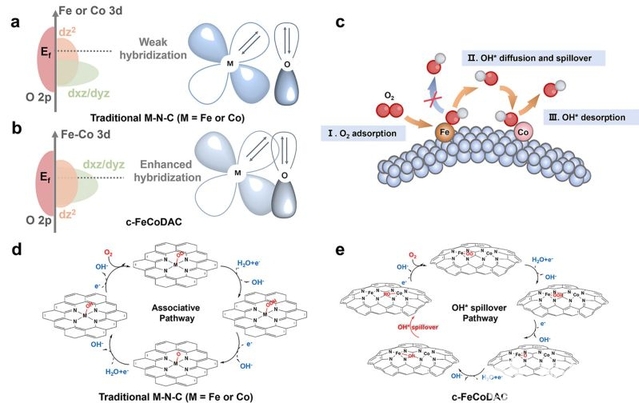
In oxygen electroreduction catalysis, current commercial Pt/C catalysts still face challenges such as high cost and poor cycling durability. To address these issues, the team designed a synthesized Fe–Co dual-site catalyst with an out-of-plane coordination structure, denoted as c-FeCoDAC. The out-of-plane configuration enhances the d-p orbital hybridization, which improves the adsorption of the OOH* intermediate, thereby shifting the rate-determining step of the oxygen reduction reaction (ORR) to OH* desorption and triggering the spontaneous spillover of OH* from Fe sites to adjacent Co sites, which significantly reduces the reaction energy barrier. This study provides new mechanistic insights for the rational design of curved M-N-C catalysts and for breaking conventional scaling relationships to achieve efficient ORR catalysis. The related work, titled “Hydroxyl Spillover in Out-of-Plane Coordinated Fe-Co Dual-Atom Catalysts to Expedite Oxygen Electroreduction”, was published in Angewandte Chemie International Edition. The first author of the paper is Dong Xiaoxiao, a 2023 PhD candidate in Marine Materials Science and Engineering at the School of Materials Science and Engineering. OUC is the first corresponding institution of that paper.