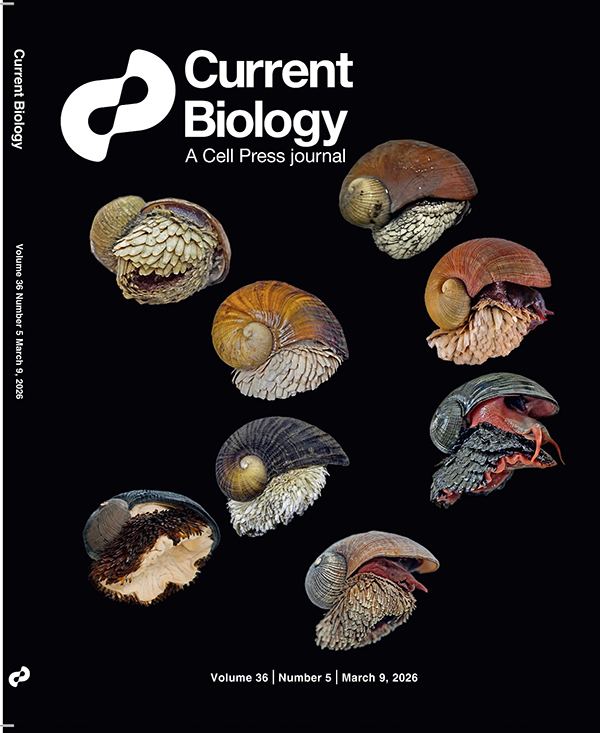
On March 9, a research team led by Professor Sun Jin from the Institute of Evolution and Marine Biodiversity at Ocean University of China (OUC), in collaboration with multiple research teams in China and abroad, published an article entitled “Dispersal and isolation of the scaly-foot snail across abyssal insular habitats and through time” in Current Biology. It was also selected for the cover of the issue.
Deep-sea hydrothermal vents host endemic ecosystems that rely on chemosynthetic primary production. However, in the vast, dark deep ocean, how organisms disperse and exchange across these scattered, insular habitats separated by hundreds of kilometers has long remained a central question in biology and marine science. The scaly-foot snail (Chrysomallon squamiferum) is an iconic species of Indian Ocean hydrothermal vents and an ideal model for studying deep-sea connectivity. It is distributed across three mid-ocean ridges in the Indian Ocean, covering a distance of more than 6,300 kilometers. Its foot is covered with imbricating scales containing iron sulfide nanoparticles that function as sites of sulfur detoxification. In 2019, it became the first vent-endemic animal to be assessed as endangered on the International Union for Conservation of Nature (IUCN) Red List. With hydrothermal vents being a major target of deep-sea mining, investigating its genetic diversity and population connectivity is therefore of great significance.
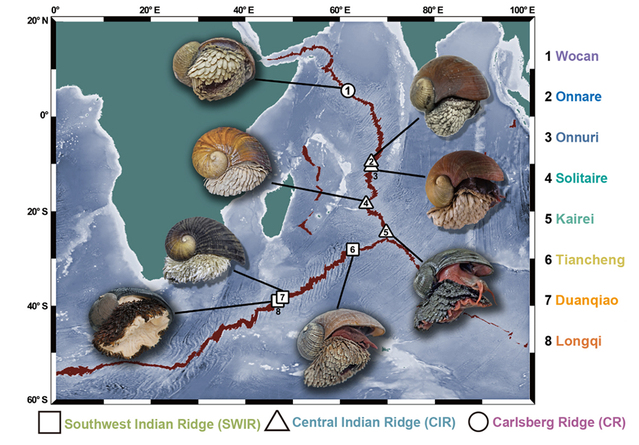
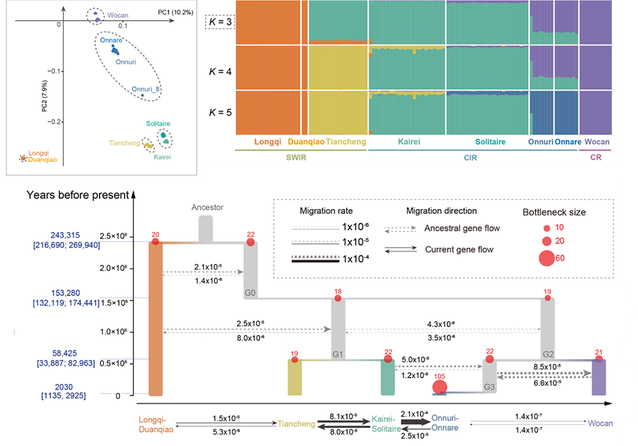
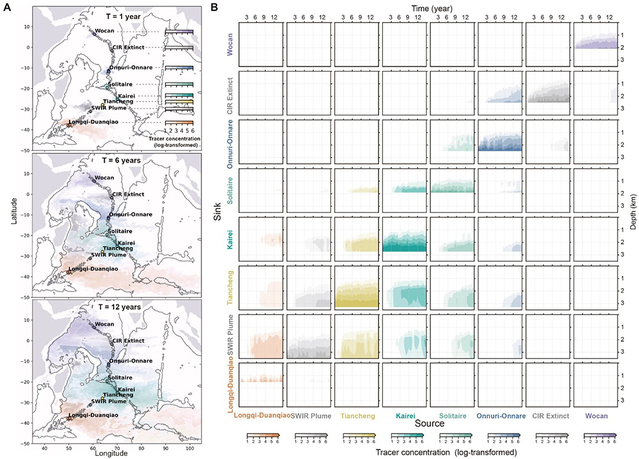
To unravel this mystery of dispersal in this deep-sea species, a team led by Professor Sun Jin at OUC, in collaboration with research institutions in South Korea and Japan, carried out a population genomic study of the scaly-foot snail. Samples were collected during 17 research cruises conducted between 2013 and 2023, covering a total of 125 individuals from eight hydrothermal vent fields across the entire known range of the species in the Indian Ocean, and were subjected to whole-genome resequencing analysis. The study identified five genetic groups of the scaly-foot snail and reconstructed its population history. The results showed that present-day scaly-foot snail populations originated from the south end of the Southwest Indian Ridge and then dispersed northward along the mid-ocean ridges, from the Longqi-Duanqiao hydrothermal vent fields at the southernmost end to the Wocan field at the northernmost end of the Carlsberg Ridge, over a timespan of approximately 240,000 years. Combined with physical oceanographic modeling, the study further revealed that deep currents are the main force driving gene flow in this species. This gene flow follows a bidirectional but asymmetrical pattern, particularly the south-to-north directionality, while transformation faults along the ridges act as natural geographic barriers restricting larval dispersal. Demographic history analyses also revealed that the extinct or unsampled “ghost populations” played an indispensable role in the long-distance dispersal of the scaly-foot snail across ocean ridges.
This study reveals how geological background, deep-ocean current circulation, and life-history traits together shape the biogeographic patterns of deep-sea organisms, further underscoring the importance of the scaly-foot snail as a flagship and umbrella species for deep-sea conservation. Against the backdrop of increasingly imminent deep-sea mining, these findings provide important scientific support for biodiversity conservation. The study particularly points out that the Longqi-Duanqiao population, which represents the source population, and the Wocan population, which lies at the end of the dispersal route and is characterized by low genetic diversity and high inbreeding, should be treated as priority targets in future deep-sea conservation planning.