On March 13, a research team led by Professor Long Hongan form the Institute of Evolution and Marine Biodiversity and the College of Fisheries, Ocean University of China (OUC), published a research article entitled “Biocontrol potential and molecular basis of predation in a marine raptorial ciliate” in The ISME Journal. The study first systematically elucidates the population dynamics underlying efficient predation by a marine raptorial ciliate and its molecular adaptative mechanisms, and assesses its potential application in the biocontrol of pathogenic ciliates in aquaculture.
Predation is a fundamental process driving energy flow and population control within microbial food webs. However, predation among marine ciliate species and its molecular basis have long remained poorly explored. In this study, the researchers successfully established a predator-prey model using the predatory ciliate Chaenea vorax as the predator and the facultatively pathogenic ciliate Uronema marinum as the prey, filling the research gap in this field.
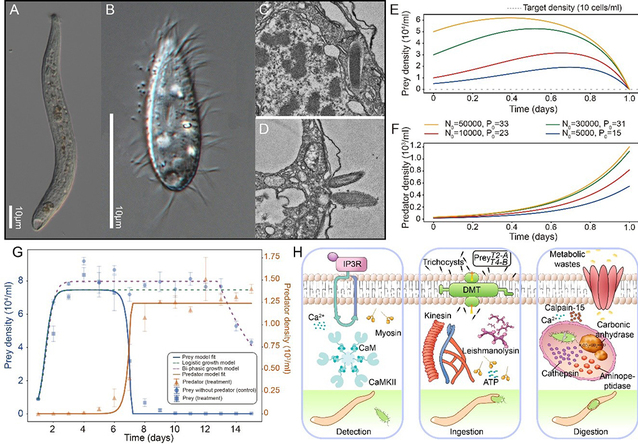
Through predation experiments and ecological modeling, the team found that C. vorax exhibits high predation efficiency, as only a few dozen individuals can eliminate the vast majority of the facultatively pathogenic ciliate U. marinum within a short period. The study further revealed that its predatory behavior relies on the coordinated action of multiple biological functions, including cytoskeletal remodeling, proteolytic activity, and toxin expulsion systems, indicating a highly coordinated adaptive strategy for predation.
Evolutionary analyses suggested that gene families linked to predatory adaptation in C. vorax have undergone significant expansion and are subject to relatively relaxed selection. In contrast, defense-related genes in the prey show evidence of strong purifying selection. Although U. marinum, as a typical r-selected species, reproduces rapidly, it remains unable to effectively withstand predation pressure from C. vorax.
The study not only provides a new perspective on predatory behavior in marine ciliates, but also offers a feasible method for the green control of pathogenic ciliates in aquaculture. C. vorax has no record of parasitism, does not carry aquatic pathogens, and combines high predation efficiency with strong environmental adaptability, making it a promising candidate as a biocontrol strain. In the future, quantitative models could be used to guide its application strategies in real aquaculture systems, combined with large-scale cultivation technologies. This approach is hopeful for promoting its practical application in aquaculture disease control and prevention.