On March 2, a research team led by Professor Zhang Juncheng from the School of Physics and Optoelectronic Engineering, Faculty of Information Science and Engineering, Ocean University of China (OUC), published an article entitled “Efficient, Reproducible, and Thermally Enhanced Organic Host-Guest Mechanoluminescence from TADF Emitters” in Matter, an international leading journal published by Cell Press. The study proposes a new strategy for constructing high-performance organic host-guest mechanoluminescent systems that achieves efficient, reproducible, and thermally enhanced mechanoluminescence across the visible spectrum, reveals the underlying luminescence mechanism, and demonstrates the material system’s potential in thermally robust stress mapping, reusable wearable devices, and real-time structural health monitoring.
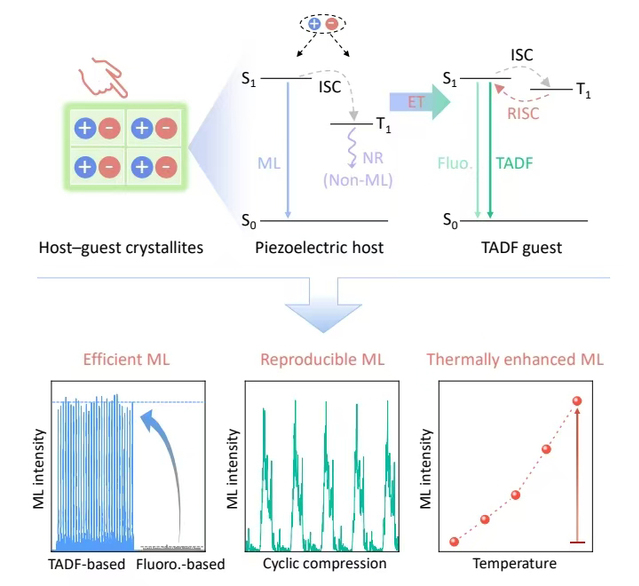
Organic mechanoluminescence (ML) refers to the emission of light from organic luminophores under mechanical stimulation. Unlike conventional photoexcitation or electrical excitation, ML uses mechanical force as the energy input and does not require an external electric field or light source. It therefore offers an environmentally benign excitation and real-time optical detection. At the same time, organic materials possess intrinsic advantages such as molecular design and synthesis, facile fabrication, mechanical flexibility, and low toxicity. These features make organic ML highly attractive for applications including stress sensing, pressure-sensitive lighting and displays, wearable devices, information encryption, and structural health monitoring. However, conventional organic ML systems based on fluorescent guests, despite their advantages in color tunability and structural flexibility, typically suffer from low efficiency, thermal quenching, and poor signal reproducibility caused by crystal damage under repeated mechanical stress. These factors not only affect device performance in practical applications but also hinder a deeper understanding of the stability mechanisms of organic mechanoluminescence.
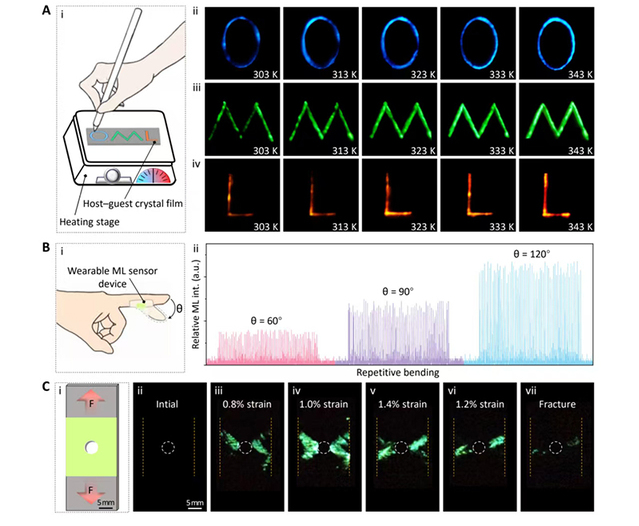
To address these bottlenecks, the research team introduces a design strategy that places the guest molecules at the center of the system by using thermally activated delayed fluorescence (TADF) emitters in combination with piezoelectric host materials that respond to mechanical force. Using the green TADF emitter 4CzIPN as a model guest, the resulting systems exhibit highly reproducible ML responses, maintaining near-cyclic stability over 900 consecutive compression cycles. Compared with conventional fluorescent guest systems, TADF-based systems display up to a 38-fold enhancement in ML intensity and pronounced thermal robustness. Morphological studies indicate that intact crystallites are preserved during cyclic deformation, which most likely drives the host’s stable mechano-electrical response and provides the structural basis for reproducible ML output. Transient photophysical measurements and theoretical calculations further suggest that TADF guests increase the effective dipole moment of the host matrix, potentially strengthening mechano-electrical coupling, while simultaneously enabling the efficient harvesting of mechanically generated triplet excitons through host-guest triplet energy transfer and charge transfer, leading to markedly improved exciton utilization. Extending this strategy to blue and red TADF emitters yields tunable ML across the visible spectrum. In addition, this material system has demonstrated application potential in thermally robust stress mapping, wearable stress sensing, and real-time structural health monitoring, laying the groundwork for advanced smart luminescent and passive sensing technologies.
OUC is the sole corresponding institution for this research. Qi Yan, a master’s student enrolled in 2023, and Associate Professor Liu Jianjun are the co-first authors of the paper. Associate Professor Liu Jianjun and Professor Zhang Jun Cheng are the co-corresponding authors.